
Key Takeaways
- Milk pasteurizers are essential for ensuring milk safety, quality, and extended shelf life.
- Homogenizers improve texture, consistency, and product stability in milk and dairy products.
- Packaging and filling machines increase production efficiency and maintain hygiene standards.
- Bulk Milk Coolers (BMCs) preserve raw milk quality by rapidly reducing milk temperature after collection.
- Cream separators help maximize profitability by producing multiple dairy products from the same milk supply.
- Milk storage and mixing tanks ensure uniform product formulation and smooth production flow.
- Clean-In-Place (CIP) systems automate sanitation, improve hygiene, and reduce production downtime.
- Choosing reliable dairy processing machinery helps improve productivity, product quality, and long-term business growth.
- Investing in the right dairy processing equipment lays a strong foundation for a successful dairy processing unit.
- Partnering with experienced dairy processing machinery manufacturers in India ensures better performance, compliance, and scalability.
Introduction
Choosing the right dairy processing equipment is important to ensure efficient operations. Whether you are exploring available machinery to expand capacity, considering pre-owned systems for a small-scale dairy unit, and sourcing solutions from trusted dairy processing machinery manufacturers in India, you must choose the right equipment to get long-term scalability and efficiency.
The right dairy processing machines also ensure precision and consistent product quality. As a specialized segment of Food Processing Machinery, dairy equipment plays a crucial role in maintaining hygiene, efficiency, and production standards.
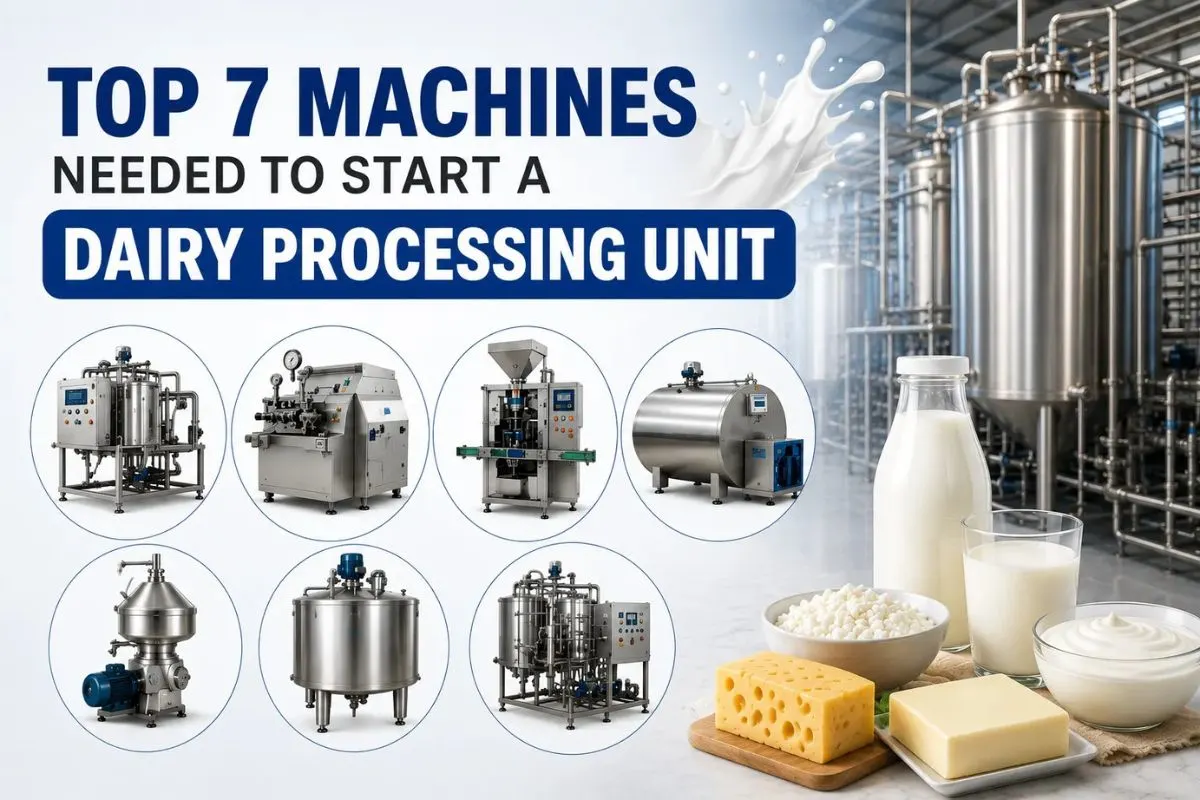
The essential machines include milk testing equipment for quality checks, bulk milk coolers for preservation, cream separators, pasteurizers, homogenizers, processing machines, and packaging machines. Let us explore the top 7 machines required for a modern dairy processing plant.
Top 7 Dairy Processing Machines Required
Here are the top 7 machines required to run the dairy processing industry
1. Milk Pasteurizers
Milk pasteurizers are the essential equipment required for dairy product manufacturing. It is used to preserve the quality and safety of milk during production. Without pasteurization, dairy products would pose significant health risks. So it makes these machines crucial in the dairy industry.
A pasteurization machine India eliminates harmful bacteria like Salmonella and E. coli through controlled heating, making milk safe to consume while preserving its nutritional value. Leading Milk Pasteurization Machine Manufacturers design advanced systems that ensure consistent temperature control, food safety compliance, and efficient dairy processing operations.
Why It Is Needed
Pasteurization is essential in dairy businesses because it ensures milk safety, meets customer expectations, and food safety regulations. It also extends product shelf life, which reduces spoilage losses during transportation and storage. You can order this equipment from trusted dairy processing machinery manufacturers in India.
2. Homogenizers
Another essential piece of equipment in dairy product manufacturing is homogenizers. It gives a smooth texture in milk, cream, and Dahi and meets customer requirements. This equipment breaks down fat molecules into small, uniform particles, and homogenizers stop separation and ensure even distribution throughout the product. Hence, it improves the overall quality and shelf life of the product.
Why It Is Needed
Using homogenizers in milk processing plant is important for customers who prefer dairy products with a consistent texture and appearance. It boosts customer satisfaction while helping brands maintain quality across every batch.
3. Packaging and Filling Machines
Packaging and Filling Machines are used to fill products into packets and package them for customs delivery. Automatic Can Filling Machine and Can Sealing Machine handle bottles, pouches, or cups with precision and minimize human contact. Modern systems also integrate labeling and date-coding functions, ensuring compliance with food safety regulations.
Why It Is Needed
Because the milk processing plant requires efficient packaging to speed up order fulfillment and improve product presentation, Packaging and Filling Machines are used. It helps your business to meet the labeling requirements and enhances product traceability across supply chains.
4. Bulk Milk Cooler (BMC)
A Bulk Milk Cooler (BMC) reduces the temperature of freshly collected raw milk to about 4°C immediately after collection. This cooling process slows down bacterial growth and preserves milk quality until processing begins. It is made with food-grade stainless steel and comes in various capacities based on daily milk collection.
Many modern systems include automatic temperature controls and energy-efficient refrigeration technology. Bulk milk coolers are commonly found in milk collection centers, dairy farms, and processing facilities.
Why It Is Needed
Milk collection and processing do not always happen at the same time. A BMC machine provides flexibility by allowing safe short-term storage and maintaining the quality needed for further processing.
5. Cream Separator
A cream separator uses centrifugal force to divide milk into cream and skim milk based on density differences. It spins milk at high speeds, allowing efficient fat extraction and precise control over milk composition. It is crucial to produce butter, ghee, cream, and standardized milk products. They are available in manual, semi-automatic, and fully automatic models, improving production efficiency and maximizing the use of raw milk.
Why It Is Needed
It is used to create multiple dairy products from the same milk supply, which increases profitability. It also helps the manufacturers to meet various market demands and consumer preferences.
6. Milk Storage and Mixing Tanks
Milk storage and mixing tanks are SS vessels used to hold, blend, and prepare milk before moving to the next production stage. It has agitators that ensure uniform mixing of ingredients like milk solids, flavors, cultures, or stabilizers.
It is widely used in the dairy processing industry and adheres to the strict hygiene standards to prevent contamination and maintain product consistency. Storage and mixing tanks come in various capacities and configurations, suitable for processing milk, yogurt, flavored beverages, and other dairy products.
Why It Is Needed
These machines are required to maintain a steady production flow. By enabling proper mixing, it ensures that every batch meets the same quality specifications and formulation needs.
7. Clean-In-Place (CIP) Systems
Clean-In-Place (CIP) systems are automated cleaning solutions that sanitize pipelines, tanks, pasteurizers, and other dairy processing equipment without disassembly. It circulates cleaning chemicals, hot water, and rinse solutions through the production network to remove residues and microbial contamination.
CIP technology reduces manual labor while ensuring thorough and repeatable cleaning results. These systems are widely used in milk processing plants and support hygiene management and compliance with food safety standards.
Why It Is Needed
The dairy processing industry requires strict sanitation. So the CIP systems are used to maintain hygiene standards. By processing automated cleaning, it cuts downtime between production cycles and helps prevent contamination-related losses.
Conclusion
Using the right dairy equipment for your industry is important because it affects your operation’s success. Make sure to buy the reliable equipment from leading dairy processing machinery manufacturers in India, like Envitro Technomech.
It helps your business to thrive successfully and contributes to India’s dairy industry. By understanding your dairy business needs and applying practical considerations, you can lay the strong foundation for a successful and efficient dairy venture.
Also Read: Fresh Milk vs Pasteurized Milk: Which Is Best for Dairy Businesses?
FAQs
Q1. What is the Required Equipment for Dairy?
Ans: The essential equipment for dairy is the milk cooling tanks, milking machines, cattle feed equipment, storage silos, and pasteurizers.
Q2. What Equipment is Used to Make Milk?
Ans: Homogenizers, separator machines, centrifuges, bottling/packaging machines, and pasteurization machines in India are the essential equipment used to make milk.
Q3. How Much Investment is Required for Dairy Processing Machinery?
Ans: The investment varies on the basis of the automation level, plant size, and production capacity. Small units start with basic equipment, whereas the larger commercial facilities require higher machinery investments.
Q4. Can a Dairy Processing Unit Produce Multiple Dairy Products?
Ans: Yes, a dairy processing unit can produce multiple products, but for this, you have to install various equipment for all purposes. It requires the installation of the cream separators, homogenizers, paneer-making machines, and packaging systems to produce milk, paneer, butter, cheese, yogurt, and more products.
Q5. Why is Chilling Milk Necessary Before Processing?
Ans: Milk chilling is necessary before processing to reduce the temperature after collection, preserve freshness, and reduce bacterial growth. It also maintains the product quality, reduces spoilage, and ensures efficient downstream processing operations.