
Key Takeaways
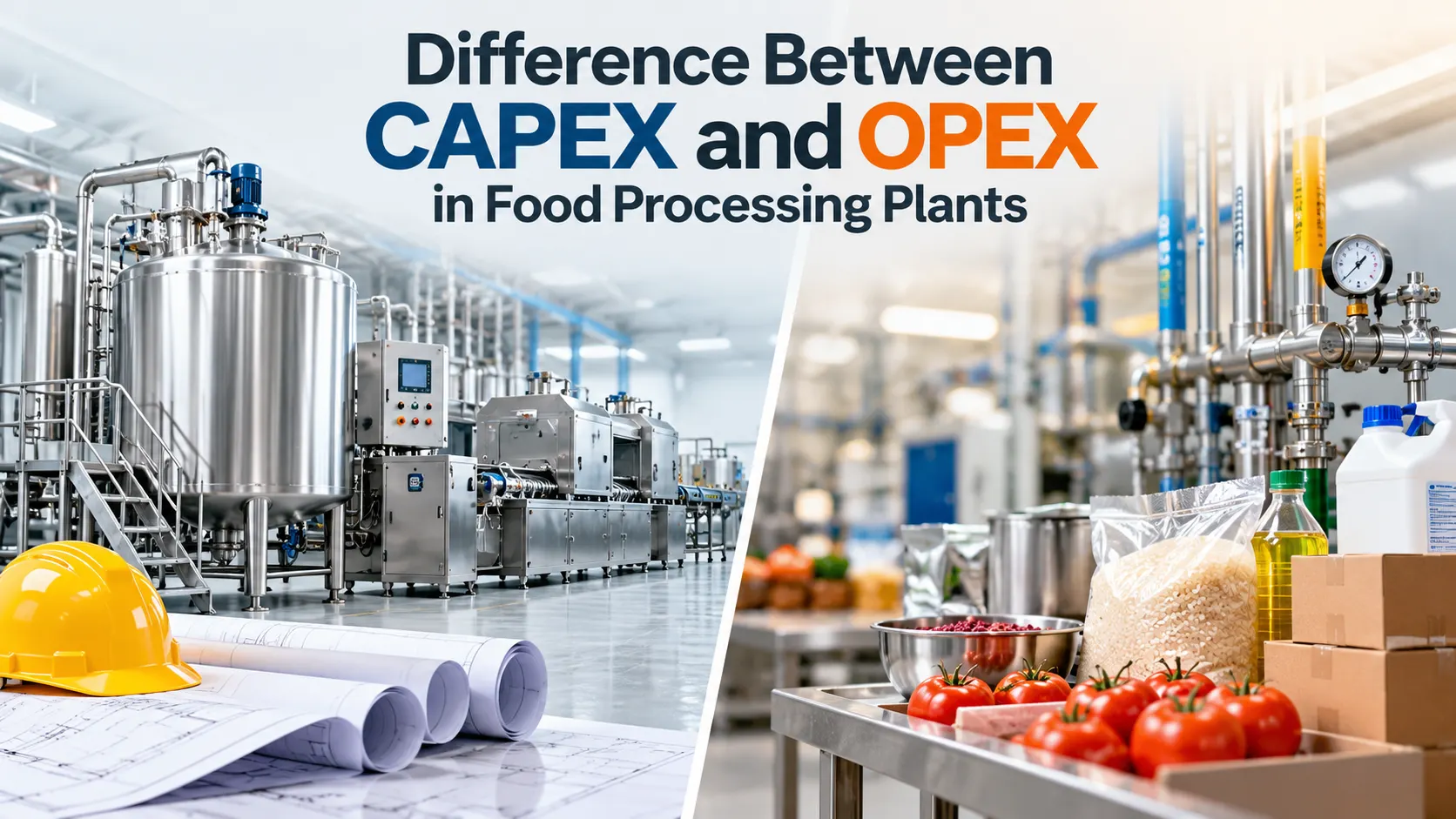
- CAPEX includes long-term investments in machinery, buildings, refrigeration systems, and production infrastructure.
- OPEX covers recurring expenses such as raw materials, labour, utilities, and routine maintenance.
- Budget Planning: Separating CAPEX and OPEX helps food manufacturers allocate budgets and manage cash flow effectively.
- Cost Control: Monitoring energy consumption, maintenance expenses, and material waste helps control operating costs.
- Equipment Investment: Comparing purchase prices, energy efficiency, maintenance needs, and equipment lifespan supports better investment decisions.
- Production Efficiency: Effective CAPEX and OPEX management helps improve resource utilisation and maintain efficient food processing operations.
Introduction
Food processing plant setup requires major investment in raw materials, machinery, infrastructure, labor, utilities and maintenance. You should ensure efficient operations to keep the production costs under control. The two main financial areas used for this aim are Capital Expenditure (CAPEX) and Operating Expenditure (OPEX).
Although both affect the cost of operating a food processing plant machinery, they have different functions. CAPEX refers to the money spent on assets which yield benefits over a number of periods, and OPEX includes the ongoing expenses associated with daily operations. Understanding the difference between CAPEX and OPEX helps the food manufacturers to draw up budgets, assess equipment investments, and manage their cash flow effectively.
What Is CAPEX in a Food Processing Plant?
Capital Expenditure (CAPEX) is the term given to the money spent on acquiring, constructing, replacing or improving long-term assets which are used by a business. Such assets can be buildings, processing equipment, refrigeration systems, packaging machinery and production infrastructure.
In food processing plants, CAPEX is associated with setting up a new facility, increasing production capacity, or improving the existing equipment to meet changing operational requirements.
What Is OPEX in a Food Processing Plant?
Operating Expenditure, or OPEX, is the amount spent on ongoing operations. It is the money that a business spends to keep its facility going. It covers the costs needed for daily production, the running of equipment, food safety, storage and distribution.
OPEX is different from capital investments in that it usually involves using the resources or services during regular business operations.
Core Differences Between CAPEX and OPEX
The CAPEX vs OPEX differences lie in the nature of the expenditure, the benefits expected, and how it is accounted for.
| Feature | CAPEX (Capital Expenditure) | OPEX (Operational Expenditure) |
| Definition | Buying, building, or upgrading long-term assets. | Paying for routine, short-term operational activities. |
| Lifespan | More than 1 year. | Less than or equal to 1 year. |
| Food Plant Examples | • Industrial ovens, chillers, and packaging lines • Factory building construction or expansions • Major automation systems and storage silos | • Raw ingredients, additives, and packaging materials • Utility bills (electricity, water, steam, gas) • Line worker and supervisory payroll • Routine cleaning, sanitation, and preventive maintenance |
| Financial Treatment | Recorded on the balance sheet as an asset and depreciated over time. | Recorded on the income statement and fully deducted in the year incurred. |
| Cash Flow Impact | High upfront cash outflow. | Smaller, recurring cash outflows. |
Examples in Food Processing Plants
Here are the examples of CAPEX and OPEX in food processing plants. These examples help you understand the OPEX and CAPEX difference.
Food Plant CAPEX Examples
- Facility construction & Infrastructure
Building a new processing hall, a cold storage warehouse, or a wastewater treatment plant.
- Major Equipment or Machinery
The acquisition of high-capacity industrial ovens, pasteurizers, packaging lines, or commercial refrigeration systems.
- Automation and upgrades
This includes the installation of robotic palletizers, new HVAC/cleanroom systems, or digital plant-control software which exceeds the company’s capitalization threshold (typically between $2,500 and $10,000).
Food Plant OpEx Examples
- Raw Materials & Consumables
Purchasing the ingredients, food additives, packaging film, labels, and sanitation chemicals.
- Utilities & Energy
For industrial use of electricity, natural gas, steam, and water needed to operate the processing lines.
- Labor and Payroll
This includes the salaries and wages paid to plant operators, line workers, food safety inspectors, and managers.
- Routine Maintenance & Repairs
Scheduled servicing, replacement of minor wear-and-tear parts, or emergency breakdown fixes
How to Identify CAPEX and OPEX in Food Processing Plants
Some expenses are easy to classify, whereas others need to be examined more closely. The examples below show how manufacturers can tell the two apart.
1. Machinery Purchase vs Routine Repairs
It is considered capital expenditure when buying a new industrial mixer or packaging machine because it is classified as a long-term asset; routine servicing, lubrication, and minor repairs, which aim to keep up the current level of performance, are generally treated as operating expenses.
A major replacement or upgrade which satisfies the relevant capitalization criteria can be considered as CAPEX.
2. Facility Construction vs Daily Cleaning
The construction of a new production building or the installation of a qualifying cold storage facility is usually considered to be part of CAPEX. The daily cleaning, sanitation supplies, and regular pest control services are generally classified as OPEX.
3. Refrigeration Equipment vs Electricity Bills
Refrigeration equipment uses a large amount of electricity. This can lead to high bills each month. Old or poorly maintained units often use more power. Upgrading to newer models can help cut costs. Regular cleaning and checks also keep them running well. Always compare the power use of different units before buying. Lower energy use means lower bills over time.
The cost of installing a new industrial refrigeration system is usually capital expenditure. The electricity required to run the system is an operating expense.
4. Production Software vs Subscription Fees
Whether software is being developed or obtained can be classified as CAPEX or not, according to the situation and the accounting requirements. Software subscriptions on a monthly basis are treated as OPEX because they cover ongoing access to a service.
5. Equipment Upgrade vs Consumable Parts
Upgrading equipment often gives long-term benefits, and replacing consumable parts only solves short-term needs. Equipment upgrades can improve performance, safety, and efficiency over time. In contrast, consumable parts need regular replacement because they wear out with use. You should balance the cost and benefit of upgrades against the ongoing expense of consumables to get the best value.
An upgrade which greatly enhances the capacity of the equipment or increases the period during which it is used may be considered as CAPEX, provided that the applicable recognition criteria are met. Regular use of consumable parts and routine maintenance are classified as OPEX.
For accounting purposes, manufacturers need to consider each transaction on its own merits rather than grouping their expenses only on the basis of purchase price.
How to Manage CAPEX and OPEX Effectively
Food processing companies can enhance their financial planning by understanding the OPEX and CAPEX difference and adopting a systematic method.
1. Set Up Individual Budgets
Keep the costs of capital projects separate from the ongoing operating expenses.
2. Prioritize Investments
You can manage the CAPEX and OPEX effectively by assessing the need for purchasing machinery in terms of production requirements, capacity limitations, food safety specifications, and the expected returns.
3. Monitor Operating Costs
Keep an eye on operating costs by regularly checking ingredient consumption, utility bills, maintenance expenses, labour costs, and waste.
4. Compare Equipment Alternatives
Evaluate the different pieces of equipment by comparing their purchase price with their energy efficiency, the requirements for servicing, and their expected operating life.
5. Maintain Accurate Records
Keep accurate records by documenting all invoices, the purchases of assets, repairs, installations, and regular service charges.
6. Review Financial Performance
You should look at the financial performance by comparing the budgeted expenses with the actual ones to spot any overspending and areas for improvement.
7. Apply Consistent Accounting Policies
Seek advice from qualified accounting professionals whenever an expense could be classified in either category. In India, businesses can consider how to treat capital assets and operating expenses when determining the relevant accounting framework and the tax requirements. The income computation standards issued by the Ministry of Finance offer guidance regarding the cost and the way tangible fixed assets should be treated.
Save the Food Processing Costs with Envitro Technomech
Envitro Technomech helps your business to enhance the operational efficiency by using reliable food processing equipment. Our suppliers also help you to choose the right machinery, upgrade the production systems, and make informed buying decisions.
From streamlining processing operations to managing resource usage, we help you and support long term growth. Get in touch with Envitro Technomech today to discuss your food processing equipment requirements.
Conclusion
CAPEX and OPEX are essential tools for financial management in food processing plants. CAPEX supports the long-term investments in buildings, infrastructure and machinery, and OPEX covers the recurring expenses such as labor, utilities, raw materials and routine maintenance.
You must understand the difference between CAPEX and OPEX to allocate the budgets, evaluate investments and manage operating costs. By tracking the expenditure categories and applying consistent accounting policies, you can make better financial decisions and maintain high production efficiency, sustainable growth and product quality.
Also Read: How to Improve Food Production Efficiency: 7 Practical Strategies
FAQs
Q1. What Is the Main Difference Between CAPEX and OPEX?
CAPEX includes acquiring or improving long-term assets, and OPEX covers recurring expenses. CAPEX is capitalized, and OPEX is expensed during the accounting period.
Q2. What Are Examples of CAPEX in Food Processing Plants?
The CAPEX examples include buying industrial mixers, installing packaging lines, building production facilities, upgrading refrigeration systems, and establishing wastewater treatment infrastructure for long-term use.
Q3. What Are Examples of OPEX in Food Processing Plants?
OPEX consists of ingredient purchases, employee wages, water consumption, electricity bills, packaging supplies, routine equipment servicing, warehousing, cleaning materials, and transportation expenses incurred during regular operations.
Q4. Can Equipment Maintenance Be Classified as OPEX or CAPEX?
Yes, the routine servicing and repairs are classified as OPEX. Major replacements or upgrades that meet the accounting recognition criteria may qualify as CAPEX, based on the nature and expected benefits.
Q5. How Can Manufacturers Reduce CAPEX and OPEX Costs?
Manufacturers can reduce CAPEX and OPEX costs by determining equipment investments carefully, improving energy efficiency, scheduling preventive maintenance, reducing ingredient waste, monitoring recurring expenses and optimizing production planning.