
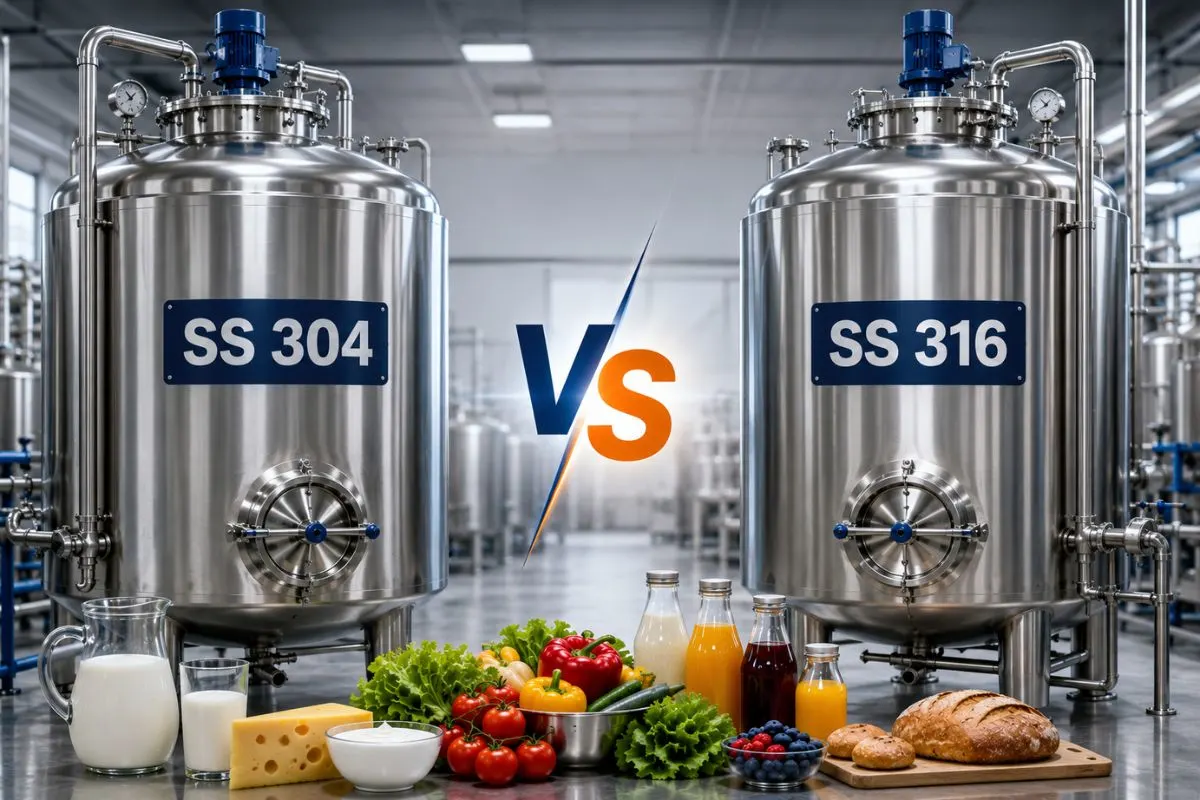
Stainless steel tanks are used throughout the food and beverage industry because of durability, corrosion resistance, hygiene, and ease of cleaning. Whether used for edible oils, storing milk, sauces, fruit juices, beverages, and processed food ingredients, SS tanks play a vital role to maintain product safety and quality.
SS 304 and SS 316 stainless steel are the two commonly food grade materials used in industry. Even though both offer excellent performance, they differ in corrosion resistance, composition, cost, and suitability for specific applications.
It is important to choose the right SS material because it affects equipment lifespan, maintenance costs, product safety, and regulatory compliance. For businesses investing in food processing machinery in Rajkot, selecting the correct stainless steel grade for storage tanks is crucial to ensuring hygiene, durability, and regulatory compliance. In this blog, we compare SS 304 and SS 316 food-grade tanks to help the food industry make an informed decision.
Understand 304 and 316 Stainless Steel
SS 304 and SS 316, both food-grade materials, are part of the austenitic family and are well known for corrosion resistance and strength. Its main differences lie in chemical composition.
- 304 Stainless Steel consists of 18% chromium and 8% nickel, and becomes highly resistant to corrosion and oxidation.
- 316 Stainless Steel has a similar structure and consists of 2-3% molybdenum, which improves its resistance to chloride and acidic environments.
The extra molybdenum in 316 stainless steel enhances its performance in saltwater and high-moisture conditions. It makes it suitable for applications exposed to strong chemicals or high salinity.
304 vs 316 Stainless Steel: Main Differences
Here are the main differences between the SS 304 and SS 316
1. Chemical Composition
The main difference between 304 and 316 stainless steel food-grade storage vessels lies in chemical composition. Both belong to the 18/8 stainless steel family, meaning they have about 18% chromium and 8% nickel. However, 316 stainless steel includes molybdenum, which changes how it performs. Let us look at the differences below
| Element | 304 Stainless Steel % | 316 Stainless Steel % |
| Carbon | 0.07 | 0.07 |
| Chromium | 18.0 – 19.5 | 16.5 – 18.5 |
| Nickel | 8.0 – 10.5 | 10.0 – 13.0 |
| Molybdenum | N/A | 2.0 – 2.5 |
Only 316 stainless steel contains molybdenum. This element helps it resist corrosion and makes it stronger. Both grades have similar carbon, chromium, and nickel levels. The molybdenum material in it offers extra protection.
2. Corrosion Resistance
The next key difference between stainless steel 304 and stainless steel 316 is the corrosion resistance. Both types resist stains and rust. The SS 316 food-grade tank is better because of its excellent corrosion resistance.
- SS 304 works well in most food processing jobs. It resists damage from cleaning chemicals and food acids.
- SS 316 is stronger against chlorides and strong acids. Molybdenum in 316 stainless steel protects it from salt, acidic foods, and tough cleaning agents.
Here is a table that shows how each grade performs
| Stainless Steel Grade | Corrosion Resistance | Key Features |
| 304 | Mild to moderate | damaged by chlorides and strong acids, especially in wet or warm places |
| 316 | High | consists of molybdenum, resists chlorides and acids, suitable for marine and chemical jobs |
3. Mechanical Properties Comparison
Both stainless steel grades offer strong mechanical strength and durability. Stainless Steel 316 performs better in highly corrosive and chemically aggressive industrial environments.
The mechanical properties comparison of SS 316 vs SS 304 is given below
| Mechanical Property | SS304 | SS316 |
| Tensile Strength | 515 MPa | 515 MPa |
| Yield Strength | 205 MPa | 205 MPa |
| Elongation | 40% | 40% |
| Density | 8.0 g/cm³ | 8.0 g/cm³ |
| Hardness | Similar | Slightly Higher |
4. Durability and Strength
Let us look at the durability and strength comparison factors of SS 304 vs SS 316
SS 304
- It provides great wear resistance and can easily handle various mechanical loads.
- It is strong and does not deteriorate even after frequent washing or rough handling.
SS 316
- It consists of the molybdenum content and has better tensile strength
- It is suitable for applications exposed to harsher conditions for longer.
Both grades are very strong, but 316 performs slightly better in severe environments.
5. Hygiene and Cleanability
Stainless steel 304 and SS 316 food-grade tanks are both non-porous, have shiny surfaces, and are easy to clean and disinfect to prevent bacterial growth. Both grades are food-grade compliant and become suitable for hygienic use. Thus, they have little difference; both grades are excellent for keeping food safe.
6. Temperature Resistance
Stainless Steel 304
- SS 304 can resist heat up to 870°C and may start to deform above this temperature.
- It is suitable for various food processing applications that require moderate heat.
Stainless Steel 316
- SS 316 operates well in high or low temperatures and can handle long-term exposure to these extremes.
- It is suitable for applications exposed to high or low temperatures.
SS304 vs SS316 Price Difference
One of the biggest difference factors between SS 304 and SS 316 is cost. Let us look at the differences below.
| Grade | Relative Cost |
| SS304 | More Affordable |
| SS316 | 20–40% Higher |
SS316 is more expensive because it consists of molybdenum, higher nickel content, and more costly alloying elements. SS 316 is useful in corrosive environments, lasts longer, and has low maintenance costs. So it becomes suitable for long-term investment.
SS 304 vs SS 316 Tanks: Suitability for Food Processing
Here is the difference table on the SS 304 and SS 316 food-grade storage vessels that shows suitability for food applications
| Feature | SS 304 | SS 316 |
| Used For | Dairy, beverage, and everyday food storage. | High-acid, high-salt, and heavy chemical cleaning environments. |
| Corrosion Resistance | Excellent for normal environments. | Superior against salts, acids, and chlorides |
| Price/Value | More affordable. | More expensive because of added nickel and molybdenum. |
| Maintenance | Easy to sanitize and clean. | Easy to maintain structural integrity under harsh chemicals. |
Applications of SS 304 vs. 316 in the Food Industry
Both SS 304 and SS 316 materials are used in the food industry, but their use cases vary on the basis of the environment and exposure to corrosive elements.
| Sector | Use for 304 | Use for 316 |
| Dairy & Beverage | Pipes, tanks, and fermentation vessels | Salted butter, cheese brining tanks |
| Household Kitchenware | Sinks, pots, pans, cutlery | Premium cookware, saltwater-contact utensils |
| Industrial Food Processing | General conveyors, bins, and packaging | Seafood processing, vinegar plants, soy sauce |
| Pharma & Medical (cross-over) | General equipment | Sterile equipment exposed to saline & aggressive cleaners |
Which Stainless Steel Should You Choose?
Here are the scenarios on the basis of which you must choose the right stainless steel material
Choose SS 316 If
- You need an affordable material
- The environment is non-corrosive
- During indoor food application
- You require easy fabrication
- You are working with freshwater systems
- You need standard food-grade SS
Choose SS 316 If
- You require superior corrosion resistance
- The application requires saltwater exposure
- The environment contains chlorides
- You work in chemical processing industries
- Where the Long-term durability is important
- The project is offshore or marine-based
Conclusion
Choosing between 304 and SS 316 food-grade storage vessels depends on the intended application and exposure to corrosive environments. 304 stainless steel is a cost-effective and durable option for most food-related uses, while 316 offers better corrosion resistance in harsher conditions.
Whether using stainless steel 304 sheets for kitchen surfaces or stainless steel 316 plates for industrial food processing, understanding the differences helps ensure the right material choice for optimal efficiency and hygiene. Always source equipment from the leading stainless steel storage tank manufacturer and make the right investment for your food industry.
Also Read: Top 7 Machines Needed to Start a Dairy Processing Unit
FAQs
Q1. Is SS 304 Suitable for All Food Processing?
Ans: Yes, it is suitable for most foods. It works with the low-acid, dry food and low-salt foods. But it is not suitable for acidic or salty foods for a long period.
Q2. What Makes the SS 316 Better for Salty Foods?
Ans: Its corrosion resistance properties and molybdenum material make it suitable for salty foods. It resists salt and chemicals easily, and is suitable for seafood, pickled foods, and brine tanks.
Q3. Is 304 More Expensive Than 316?
Ans: No, SS304 is not more expensive than SS316. It is more affordable because it does not consist of molybdenum and does not raise production costs.
Q4. How Much More Expensive is SS 316 Compared to SS 304?
Ans: SS 316 tanks cost 20-40% more than SS 304 tanks because of the molybdenum and higher nickel content. The exact price difference varies on the basis of tank size, thickness, and market conditions.
Q5. Which SS Tank Lasts Longer in Food Processing Plants?
Ans: SS 316 lasts longer because it offers a longer lifespan in corrosive environments. It has superior resistance to salts, acids, and cleaning chemicals and lasts longer in food processing plants. SS 304 also lasts longer, but it works under normal food processing conditions only.