
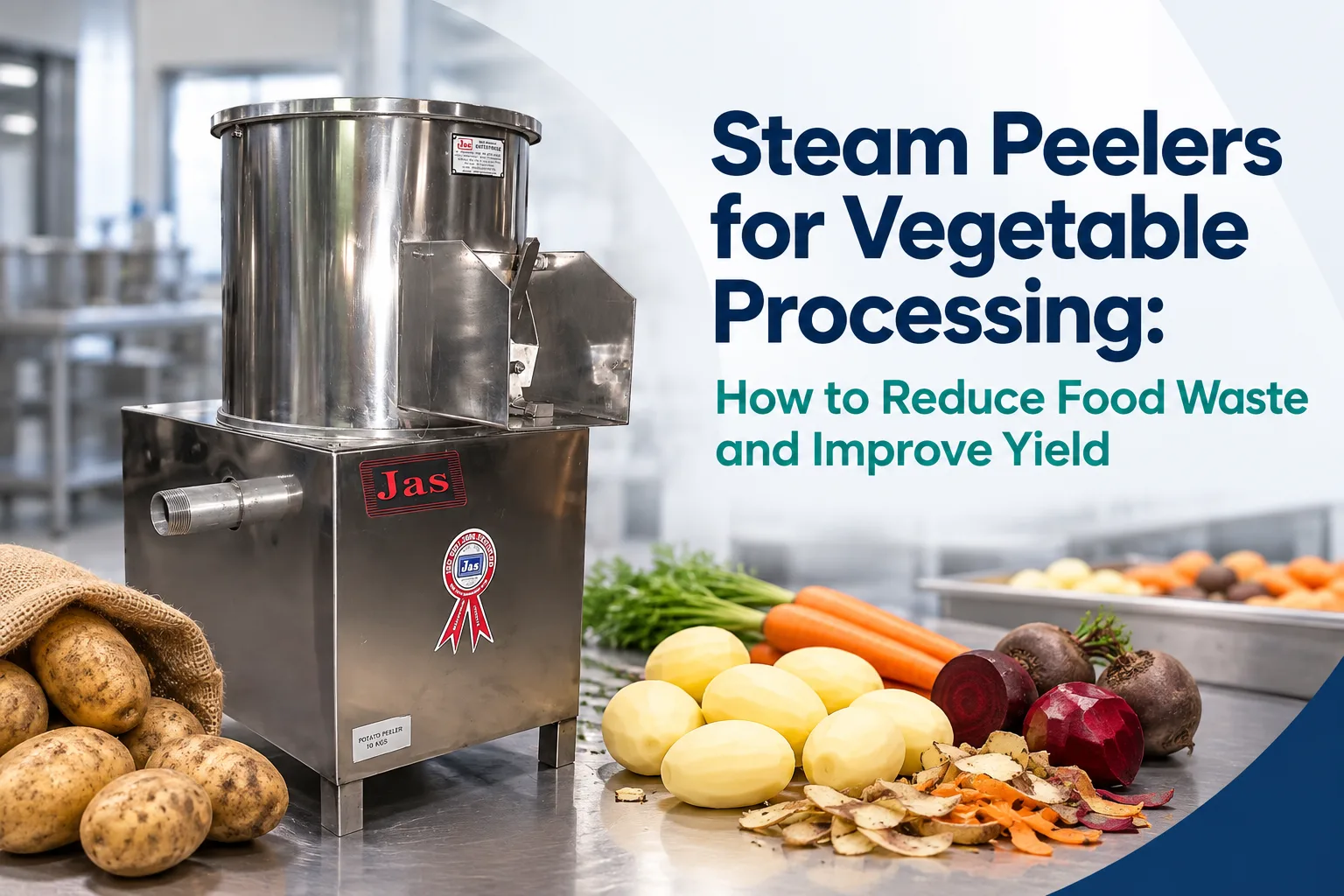
For processors, food waste continues to be a significant problem. Every year, households, food-service businesses, and retailers waste significant amounts of food, according to the United Nations. Better processing can prevent a considerable share of this loss. Steam peelers help remove vegetable skins rapidly, evenly and with less edible meat loss.
A modern steam peeling machine can improve product consistency, labour productivity, yield, and hygiene in vegetable processing, labour productivity, yield, and hygiene. Peeling is more than just a simple preparation procedure for processors working with potatoes, carrots, beets and similar crops. Profitability is directly impacted. Inadequate peeling reduces product quality, increases rework and produces waste.
Why Is Peeling Vegetables Important?
Conventional peeling techniques frequently depend on manual labour, blades or abrasive surfaces. While the skin may be removed using these techniques, valuable flesh may also be removed.
Uneven vegetables create an additional problem. Steam peeling uses controlled steam pressure and heat. The steam loosens the skin from the vegetable surface. After steam exposure, a rapid pressure release helps loosen and separate the softened skin from the vegetable surface. This process offers several practical benefits:
- Reduces unnecessary flesh removal.
- Produces a more consistent peeled surface.
- Supports faster production cycles.
- Decreases dependence on manual labour.
- Improves cleanliness and process control.
- Helps maintain uniform product quality.
The exact savings depend on crop variety, size, moisture, pressure and operating time. Therefore, processors should evaluate results through product trials before final installation. A reliable peeling line can turn small yield improvements into meaningful annual savings. Explore how better peeling can support your production goals.
How Do Steam Peelers Improve Yield?
Yield is one of the most important performance measures in vegetable processing. Even a small reduction in peel loss can create major value at industrial volumes.
For instance, ineffective peeling could result in hundreds of kilograms being lost by a company that processes ten tons of potatoes per day. For a plant processing 10 tonnes of potatoes per day, recovering an additional 2% of usable product could mean approximately 200 kg of extra saleable product per day. Operating days and product value determine the commercial impact.
| Processing factor | Traditional challenge | Steam peeling advantage |
| Skin removal | Uneven and inconsistent | More uniform separation |
| Flesh loss | Often higher | Potentially lower |
| Labour requirement | Greater manual involvement | More automated operation |
| Product hygiene | Depends on handling | Enclosed processing environment |
| Output consistency | Varies by operator | Controlled through settings |
Steam peeling also supports better product presentation. However, the machine must match the crop and production volume. Excessive steam exposure may affect texture. Insufficient exposure may leave skin behind.
Proper calibration is essential. A steam peeling machine for vegetable processing should therefore be selected after reviewing product specifications and downstream requirements.
Choosing the Right Steam Peeler
Not every processing plant has the same needs. A small unit may require a compact solution. A large facility may need continuous feeding, automated discharge and integration with washing and cutting systems. Consider these points before purchasing:
- Vegetable types and average dimensions.
- Required hourly or daily capacity.
- Batch or continuous processing preference.
- Steam pressure and energy requirements.
- Product temperature after peeling.
- Cleaning and sanitation procedures.
- Available floor space.
- Compatibility with existing conveyors.
- Material grade and food-contact safety.
- Installation and after-sales support.
Envitro Technomech’s broader portfolio includes vegetable processing plants, canning plants, retort systems, tanks, and related food-processing equipment. vegetable processing plants, canning plants, retort systems, tanks and related food-processing equipment.
This wider capability can help businesses plan a complete processing line instead of purchasing disconnected machines. The best equipment is not always the largest. It is the machine that delivers stable results without creating unnecessary energy, maintenance, or space costs.
Food Safety and Operational Benefits
Steam peelers can support hygiene by reducing direct handling. Steam does not replace hygienic design, validated cleaning, or safe water management. Food processors must still follow proper cleaning and sanitation schedules. Steam does not replace hygienic design, validated cleaning, or safe water management. Key operational benefits include:
- Fewer manual handling points.
- Easier process standardization.
- Better production planning.
- Reduced dependence on operator technique.
- Smoother integration with blanching or cutting.
- More predictable downstream performance.
In the middle of the production line, peeling can influence every later stage. Excess flesh loss reduces saleable output. Uneven peeling affects cutting accuracy. Poor surface quality can also create packaging and appearance concerns.
What Advantages Does Steam Peeling Offer?
A steam peeling machine for vegetable processing can speed up production and decrease product loss. It loosens the skin without relying entirely on abrasive contact. This may help preserve more edible flesh than less controlled peeling methods. The process can also lower manual intervention. Workers can focus on inspection, quality control and line management. However, results vary according to vegetable type, operating settings and machine design.
Processors should measure peel loss, throughput, energy consumption and product quality. These figures provide a more accurate return-on-investment assessment than a general equipment claim. For best results, combine steam peeling with proper washing, conveying and quality inspection. Explore how integrated processing can improve your plant’s performance.
Conclusion
Vegetable processors can cut waste, preserve edible flesh, and increase production consistency by using steam peelers. Better hygiene, reduced labour costs and easier integration with cutting, blanching, freezing and packaging lines are further benefits of using steam peeling equipment for vegetable processing machine.
Businesses can achieve higher yields, lower operational losses, and more dependable quality with the right equipment selection, calibration and maintenance. Learn how effective steam peeling may boost your output and profitability by upgrading your processing line right now.
Also Read: Steam Peelers vs. Abrasive Peelers: Key Differences, Benefits & Applications
FAQs
Q1. How Does a Steam Peeler Improve Vegetable Processing Efficiency?
Ans: Steam peelers automate skin removal, reduce manual handling, and support faster, more consistent processing at industrial volumes.
Q2. Can Steam Peeling Improve Vegetable Processing Yield?
Ans: Yes, controlled steam peeling can reduce unnecessary flesh loss and improve usable product yield compared with less controlled peeling methods.
Q3. What Factors Affect the ROI of a Steam Peeling Machine?
Ans: ROI depends on processing capacity, yield improvement, labour savings, steam and energy consumption, maintenance costs, and operating hours.
Q4. Can a Steam Peeler Be Integrated Into an Existing Processing LINE?
Ans: Yes, steam peelers can be integrated with equipment such as washers, conveyors, cutters, blanchers, and other downstream processing systems, depending on the plant layout.
Q5. How Should a Steam Peeler Be Selected for Industrial Vegetable Processing?
Ans: Consider vegetable type, product dimensions, required capacity, steam requirements, peeling performance, energy use, cleaning needs, and compatibility with the existing production line.