
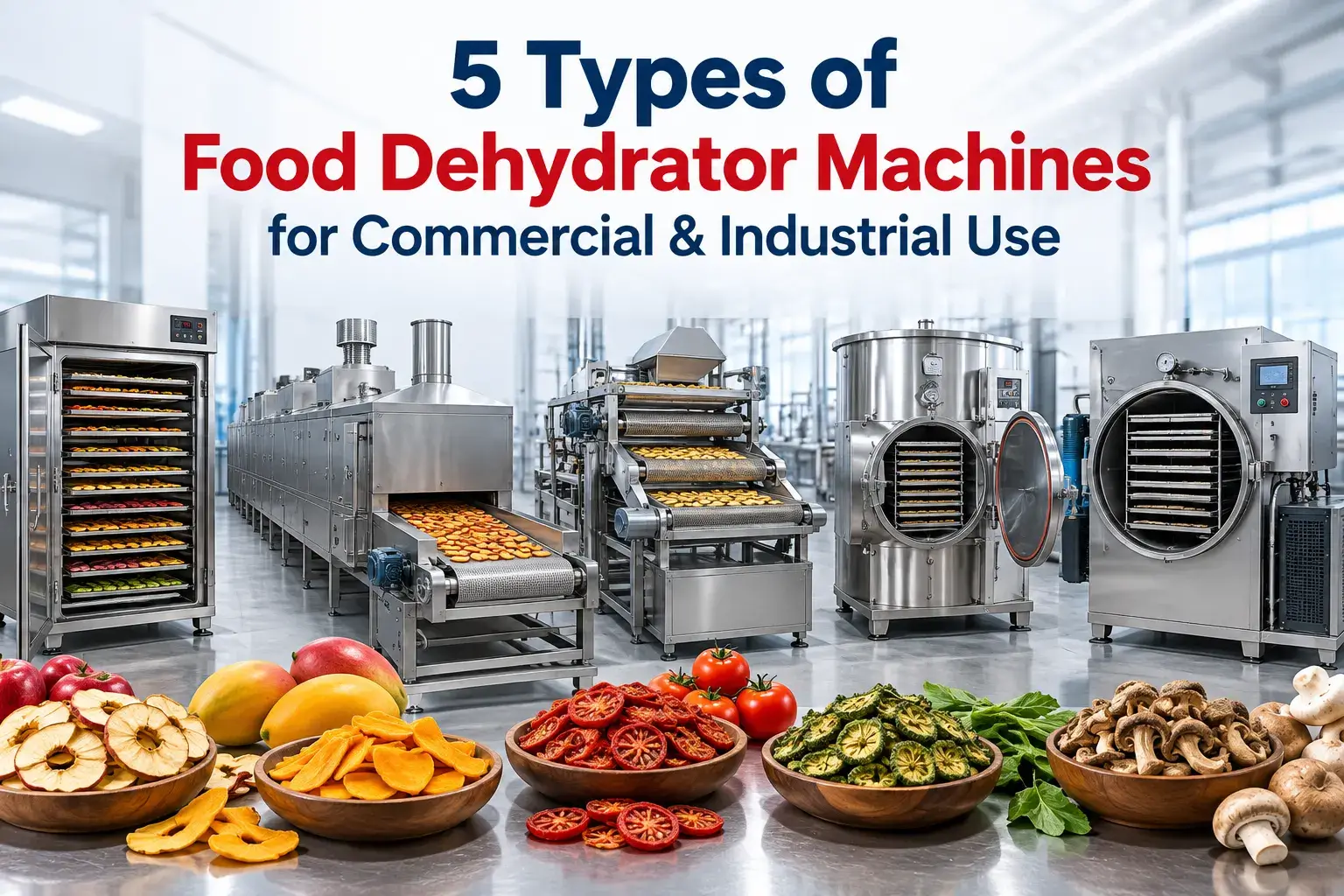
India produces high volumes of fruits and vegetables every year. In 2024-25 FY, government sources say India produced 117.65 million tons of fruits and 217.80 million tons of vegetables. As such, the requirement for preservation and value addition to these products is rising consistently.
A food dehydrator machine helps to reduce the moisture content of the product under controlled conditions to increase its shelf life, making it a crucial element for food manufacturers and processors.
What Is a Food Dehydrator Machine?
A food dehydrator machine is primarily used to reduce the moisture content of food products under controlled conditions. Such a process is suitable for fruits, vegetables, herbs, spices, and other such products.
Want to know more about the machines required for dehydration of your product? Envitro Technomech provides food processing machinery and customized solutions for dehydration.
How Does a Food Dehydrator Machine Work?
The working principle of a food dehydrator machine involves placing the product on trays, racks, or any other suitable mechanism and subjecting it to heated air, which draws out the moisture. The parameters of temperature and airflow are adjusted to suit the type of product, and once the required level of dehydration is achieved, the product is cooled and packed in moisture-proof packing.
Top 5 Food Dehydrator Machines
1. Tray/Cabinet Dehydrator
Tray-based or cabinet dehydrators are commonly used in small and medium-level commercial production. They consist of several layers of trays placed in an insulated chamber and allow adjustable temperature settings. They are ideal for use with fruits, vegetables, herbs, spices, and other such products.
2. Tunnel Dehydrator
Tunnel dehydrator machines are suitable for higher levels of commercial production. These machines comprise a long tunnel and use heated air to draw out the moisture from the product as it moves through the tunnel.
3. Continuous Belt Dehydrator
A continuous belt dehydrator uses a conveyor belt to move the product through a controlled hot-air drying zone. Air temperature and flow rate can be adjusted according to the product and required moisture level.
By controlling the air temperature and flow rate, the desired degree of drying can be achieved. This type of dryer is used mainly at an industrial level and is necessary for ensuring the quality of the dried product and for increasing the production rate.
4. Vacuum Dehydrator
Vacuum dehydrator is used to remove the moisture from the product under reduced pressure and lower temperature as compared to hot-air dehydration. The selection of this method depends upon the properties, quality, and economic viability of the product to be dehydrated.
5. Freeze Dryer
A freeze dryer is used when preserving product quality, structure, flavour, or heat-sensitive characteristics is particularly important. The product is frozen and moisture is removed through sublimation under vacuum. It is a specialized and capital-intensive process, as the product is first frozen before the moisture is removed using a vaporization process.
The Key Applications
Dehydration allows for the conversion of raw materials into a value-added product with a significantly higher shelf life. Its application range includes:
- Dried fruits and fruit pieces
- Dried vegetables
- Herbs and spices
- Vegetable flakes, powder
- Snack ingredients
- Soup and seasoning ingredients
- Ready-to-use ingredients
- Agro-processing products
Do you wish to explore a solution for the dehydration of a specific product? Envitro Technomech provides customized Food Processing Machinery according to your requirements.
The Key Benefits
Reducing moisture can help slow microbial growth and deterioration when the product is properly processed and packaged.
- Increased shelf-life
- Better storage and transportation
- Production of value-added products
- Consistent quality compared to open sun drying
- Opportunity to scale production
Specifications to Look Into
While making the purchase, it is important to review the specifications that suit your requirements:
| Specs | Description |
| Capacity | The volume of product to be dehydrated |
| Temperature range | Applicable temperature range |
| Airflow | Uniformity of hot air |
| No. of trays | Batch size capacity |
| Construction material | Material of construction – stainless steel is preferred |
| Automation level | Manual vs. automated operation |
| Power consumption | Energy required for operation |
| Installation support | Commissioning and training support |
| FSSAI hygiene compliance | FSSAI requires corrosion-free, non-toxic, and easily cleanable and disinfectable surfaces |
Conclusion
Envitro Technomech provides food dehydration and processing machines. Customization, installation, commissioning, maintenance, and other after-sales services are provided by the company for commercial and industrial applications.
Looking for a food dehydrator machine in India? Contact Envitro Technomech to provide your product and equipment requirements.
Also Read: Steam Peelers for Vegetable Processing: How to Reduce Food Waste and Improve Yield
FAQs
Q1. What Products Can Be Processed in an Industrial Food Dehydrator?
Ans: Although the conditions and time are variable, you can dry everything from fruits and vegetables to herbs and spices in a food dehydrator.
Q2. What Affects Food Dehydrator Machine Capacity?
Ans: A food dehydrator machine’s capacity can be calculated based on the product that needs to be dehydrated, moisture content, quantity of the product that needs to be processed, tray or belt area, amount of airflow, time, and production rate.
Q3. Can Food Dehydrator Machines Be Customized?
Ans: Yes, food dehydrator machines can be customized based on the product, capacity, design, level of automation, temperature, airflow, and other additional features based on the processing application.
Q4. What is the Difference Between a Commercial and Industrial Food Dehydrator?
Ans: Commercial dehydrators are generally designed for smaller production volumes, while industrial dehydrators offer higher capacity, automation, and continuous processing options.
Q5. How Can a Food Dehydrator Reduce Processing Costs?
Ans: A properly selected dehydrator can improve drying consistency, reduce manual labour, optimize energy use, and support higher production efficiency.