
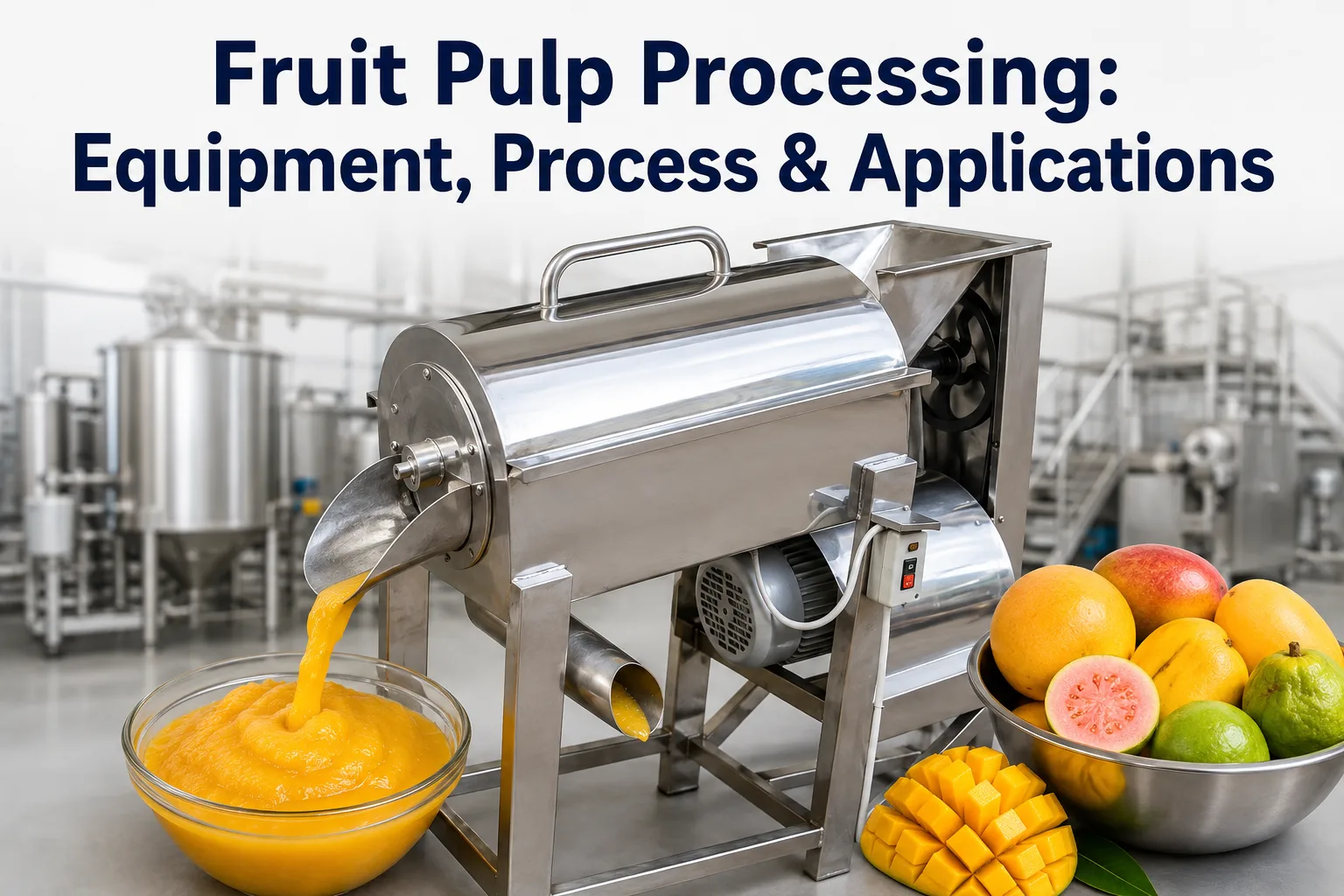
India’s large fruit production creates significant opportunities for value-added food processing. The country produced around 117.65 million tonnes of fruits in 2024–25, according to final horticulture estimates.
This significant yield also calls for efficient processing of the produce. Fruit pulp finds applications in beverages, purees, sauces, jams, desserts and various other food items.
The right fruit pulp processing equipment can help processors extract pulp efficiently, reduce manual effort and ensure consistent production. Selection of equipment should be based on a fruit’s nature, production capacity, hygiene requirements and plant layout.
What Is Fruit Pulp Processing?
The resulting pulp can be used directly or further processed into beverages, purees, concentrates, sauces and other food products. The process typically includes fruit inspection, washing, sorting, preparation, crushing, pulping and finishing. Depending on the final product, sometimes pasteurisation, concentration, filling and packaging may be added.
Envitro Technomech offers pulping solutions ideal for mango, tomato, banana, papaya and other fruits and vegetables.
How Does a Fruit Pulp Processing Line Work?
A commercial line performs several steps to extract uniform pulp from the produce.
- Inspection: Unripe, contaminated or damaged fruits are separated.
- Washing: Dirt and impurities are removed to promote hygiene.
- Sorting: Fruits are graded and unsuitable or damaged produce is removed.
- Preparation: Depending on the fruit, peeling, destoning, cutting or size reduction may be carried out before pulping.
- Crushing: Fruit is broken down into smaller pieces to feed into a pulper for further extraction.
- Pulping: The usable portion of the fruit is extracted from the seeds, skin and fibrous matter.
- Finishing: The extracted pulp is refined to remove remaining fibres, seeds or coarse particles and achieve the desired consistency.
- Pasteurisation / Heat Treatment: because that’s more recognisable to people searching for a Fruit Pulp machine.
- Packaging: The pulp is filled and sent for packing, based on the application.
What Equipment Is Used for Fruit Pulp Processing?
| Equipment | Purpose | Main Benefit |
|---|---|---|
| Fruit Washer | Cleans fruit | Supports hygiene |
| Fruit Crusher | Reduces fruit size | Improves preparation |
| Fruit Pulper | Separates pulp | Produces usable pulp |
| Pulper Cum Finisher | Refines pulp | Improves texture |
| Pasteuriser | Applies controlled heat | Supports product safety |
| Mixing Tank | Blends ingredients | Improves uniformity |
| Evaporator | Removes water | Produces concentrates |
| Filling Machine | Fills containers | Improves efficiency |
| Packaging Machine | Seals products | Supports final handling |
Envitro Technomech offers fruit and vegetable processing plants, pulp plants, tanks, evaporators, filling systems and packaging machinery.
Applications of Fruit Pulp Processing Equipment
In the F&B industry, fruit pulp processing equipment has varied applications, such as for:
- Fruit juices and beverages
- Fruit nectars
- Mango pulp and puree
- Tomato puree
- Ketchup and sauces
- Jam and jelly
- Fruit desserts
- Canning products
- Ready-to-serve beverages
- Industrial food ingredients
FSSAI’s food standards comprise several categories of processed fruit and vegetable products. This includes fruit pulp and puree products that find diverse applications in Food Processing Machinery.
Explore solutions for your specific application.
Key Advantages
- Higher Production Efficiency: Automated pulping can process more fruits than manual extraction.
- Consistent Product Quality: Controlled processing can yield more consistent pulp qualities.
- Better Resource Utilisation: Modern pulp extractors can help achieve higher utilisation rates of the incoming fruits.
- Easier Production Scaling: A well-designed production line can incorporate additional machinery as requirements evolve.
Explore the benefits of modern processing equipment.
Technical Specifications to Consider
- Capacity
- Construction Material
- Automation Level
- Fruit Type Suitability
- Plant Integration
Select a configuration based on your complete production line.
Conclusion
India’s rising fruit production is witnessing greater focus on processing and value addition. The right fruit pulp processing equipment can help manufacturers improve processing efficiency and achieve more consistent production. Envitro Technomech presents a complete range of fruit and vegetable processing machinery, pulp plants, tanks, evaporators, fillers and allied systems to meet all requirements and specifications.
Ready to plan your fruit processing line? Discuss your capacity, fruit and equipment requirements with us today.
Also Read: Retort Machine vs Autoclave: Key Differences for Food Processing
FAQs
Q1. What is Fruit Pulp Processing Equipment Used for?
Ans: It is ideal for extracting the edible portion of a fruit. A complete fruit pulp processing line also encompasses washing systems, crushing machinery, finishing equipment, pasteurisation units, concentrators, filling and packaging machinery.
Q2. Which Fruits Can Be Processed Using Such Equipment?
Ans: Suitable pulping systems can be used for processing mango, papaya, banana, guava, tomato and several other fruits. However, each fruit has its characteristics, such as fibre and seed structures, and therefore, the equipment should be selected considering the raw materials and intended use.
Q3. What is the Difference Between a Pulper and a Pulper Cum Finisher?
Ans: A pulper is used to extract the edible portion of the fruit from undesirable fibre and seeds. A pulper cum finisher offers separation of unwanted fibres, resulting in a more refined output when the product requires controlled texture.
Q4. What Factors Affect Fruit Pulp Processing Equipment Capacity?
Ans: Equipment capacity depends on the fruit type, pulp characteristics, processing stages, required output and production line configuration.
Q5. Can Fruit Pulp Processing Equipment Be Used for Multiple Fruits?
Ans: Yes, suitable processing systems can handle multiple fruits, but equipment configuration may need to vary based on fibre, seeds, viscosity and pulp characteristics.