
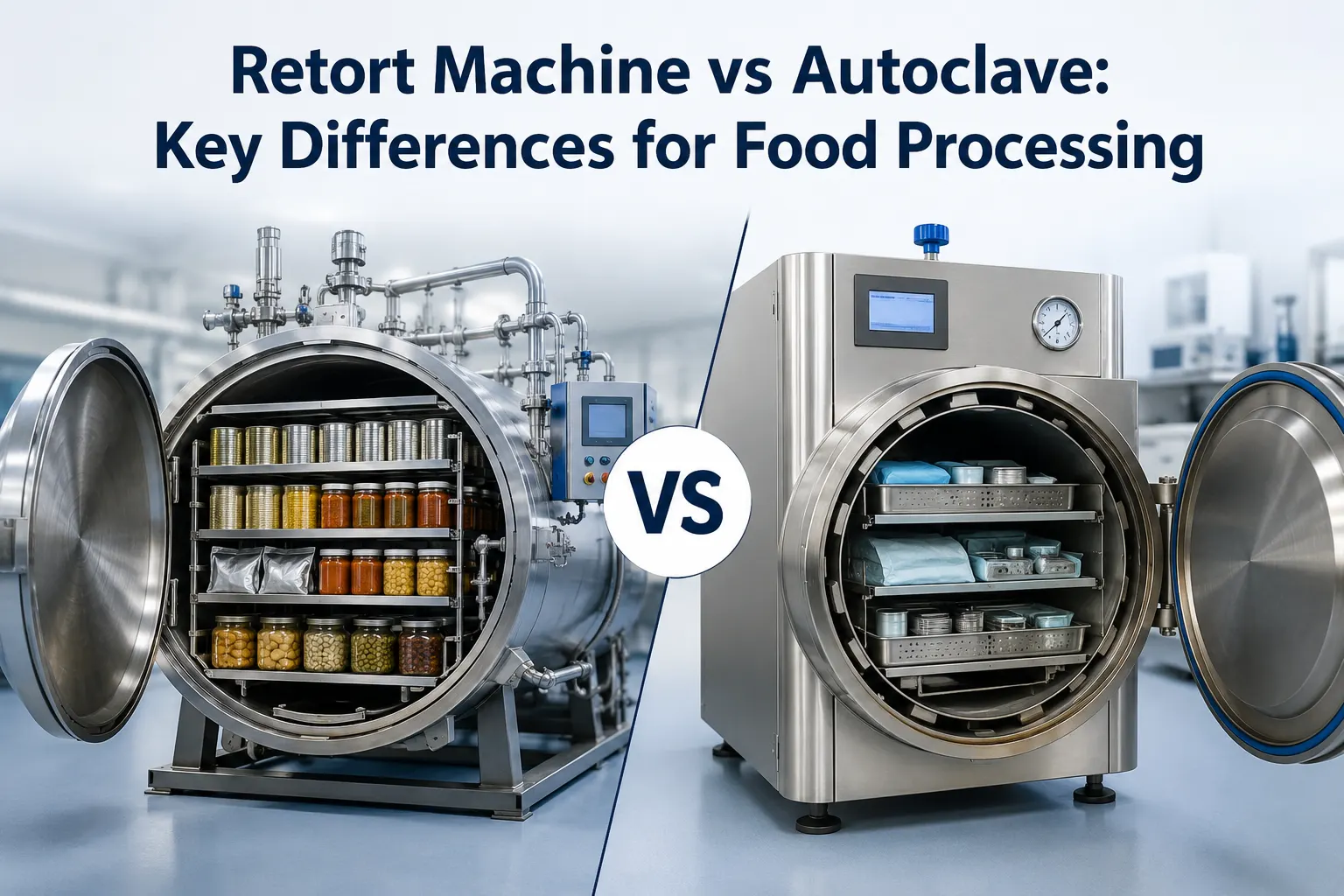
Retort machines and autoclaves both use controlled heat and pressure, but they are designed for different processing requirements. A retort is primarily used for the commercial thermal processing of sealed food products, while an autoclave is mainly used for sterilising equipment, materials and instruments.
Manufacturers must compare retort machine vs autoclave systems considering key technical differences. This will help make the right choice, improve production efficiency and enhance product safety.
What Is a Retort Machine?
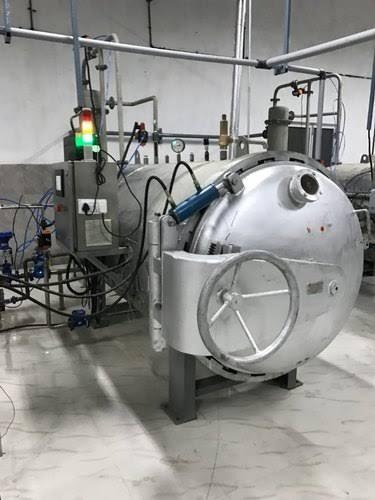
A retort machine is a closed pressure vessel for thermal processing of food. Controlled heat and pressure reduce microorganisms to achieve the required level of commercial sterility and shelf stability. Retort systems are used to process products such as canned foods, ready-to-eat meals, sauces, soups and other packaged foods. Depending on the retort design, heating can be achieved using steam, hot water or water spray systems.
Processing in retort systems helps in various types of packing including cans, jars, trays, bags and more. Depending on the equipment design, pressurised steam, hot water, and water spray can be used for heating.
What Is an Autoclave?
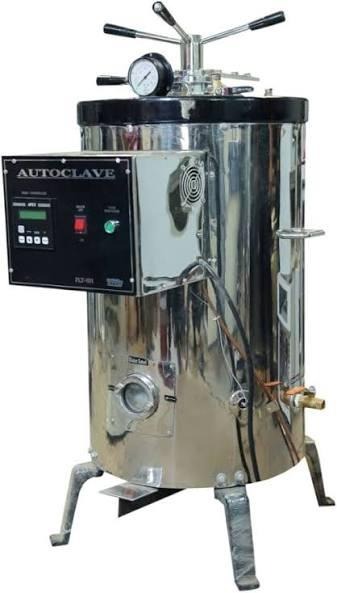
An autoclave is a pressure vessel for sterilising objects through steam disinfection. Autoclaves are widely used in medical institutions for sterilising equipment, laboratory apparatus and glassware. Industrial vertical autoclave machine play a critical role in many pharmaceutical and other manufacturing processes.
Both systems use controlled heat and pressure, but their chamber design, loading configuration, controls and processing objectives can differ significantly. Therefore, a general-purpose autoclave should not automatically be considered a substitute for a food-processing retort.
Retort Machine vs Autoclave: Key Differences
The biggest difference found comparing retort machines vs autoclave systems is their application-specific design.
| Factor | Retort Machine | Autoclave |
| Primary purpose | Thermal processing of packaged foods | Sterilisation of equipment and materials |
| Common industries | Food & beverage | Medical, laboratory, pharmaceutical |
| Product/load | Sealed food packages | Instruments, materials and containers |
| Main objective | Food safety, shelf stability and product quality | Sterilisation |
| Package protection | Critical during heating and cooling | Generally load-dependent |
| Process control | Temperature, pressure, time and cooling | Temperature, pressure and sterilisation cycle |
| Packaging compatibility | Designed for cans, jars, pouches, trays, etc. | Depends on chamber and load |
| Cooling requirements | Controlled cooling is an important part of the cycle | Depends on application |
What Are the Advantages of a Retort Machine?
- Enables shelf-stable packaged food production
- Supports different food packaging formats
- Provides controlled thermal processing
- Helps maintain package integrity during processing
- Supports repeatable processing cycles
- Can be integrated into automated production lines
Explore how retort processing can support your food manufacturing operation.
What Are the Advantages of an Autoclave?
Autoclaves remain highly useful where sterilisation is the main requirement. Their benefits include:
- Reliable steam-based sterilisation
- Controlled temperature and pressure
- Repeatable sterilisation cycles
- Suitability for heat-resistant materials
- Established use in healthcare and laboratories
- Multiple chamber and loading configurations
Retort Machine vs Autoclave: Which Is Better for Food Processing?
For commercial food processing, a purpose-built retort is generally the more appropriate choice.
The reason is straightforward. Retorts are designed around packaged food products and their processing requirements.
A food manufacturer needs more than sterilisation. The system supports:
- Controlled heat penetration
- Package integrity
- Product quality
- Consistent processing
- Cooling and pressure management
- Production throughput
- Food-processing hygiene
- Integration with other equipment
An autoclave can provide heat and pressure sterilisation. However, its design may not address the complete requirements of a commercial food-processing line.
What Specifications Should You Compare?
When evaluating a retort machine vs autoclave, compare specifications that affect actual production.
- Capacity
- Temperature and pressure range
- Heating method
- Automation
- Construction
- Safety features
- After-sales support
Compare the complete system, not just the purchase price.
Conclusion
The choice between a retort machine and an autoclave depends primarily on the intended application. For commercial processing of sealed food products, a purpose-built retort provides the controls needed for thermal processing, package integrity and consistent production. Autoclaves remain the appropriate choice for many sterilisation applications involving equipment, instruments and other materials.
Also Read: How Does a Retort Machine Work? Working Principle & Process
FAQs
Q1. Is an Autoclave Suitable for Food Processing?
Ans: An autoclave is not by default designed for processing of packed food, as opposed to a purpose-built retort machine.
Q2. Why is a Retort Machine Preferable for Packaged Food?
Ans: A retort is designed for thermal processing of sealed food. It is possible to apply various thermal methods including direct steam, hot water, water sprays, and so on. In other words, a retort machine is a versatile piece of food processing equipment.
Q3. What Should I Check While Buying a Retort Machine?
Ans: The design of the retort should account for the physical properties of packaging material and ensure its integrity during thermal cycling. Appropriate vacuum levels, steam pressure, and so on should be accounted for.
Q4. Can Retort Machines Process Different Types of Food Packaging?
Ans: Yes. Retort machines can be designed to process cans, glass jars, pouches, trays and other heat-resistant sealed packaging formats.
Q5. What is the Main Difference Between Retort Processing and Autoclave Sterilisation?
Ans: Retort processing focuses on safely processing sealed food products for shelf stability, while autoclave sterilisation is primarily used for equipment, instruments and other materials.