
India’s food processing industry is undergoing a transformation towards organized, automated, and high-quality production. Food processors and manufacturers are increasingly seeking specialised equipment for controlled heating and consistent production.
According to the Ministry of Food Processing Industries, the sector recorded a 6.55% growth rate from 2015 to 2024 and contributed 7.93% to India’s Gross Value Added (GVA) in 2022–23.
It is essential to understand the steam jacketed kettle advantages to determine whether it can meet the specific needs of the manufacturer. The selection of equipment is based on the amount of production, method, material, temperature, cleanability, product features, and maintenance.
What Is a Steam-Jacketed Kettle?
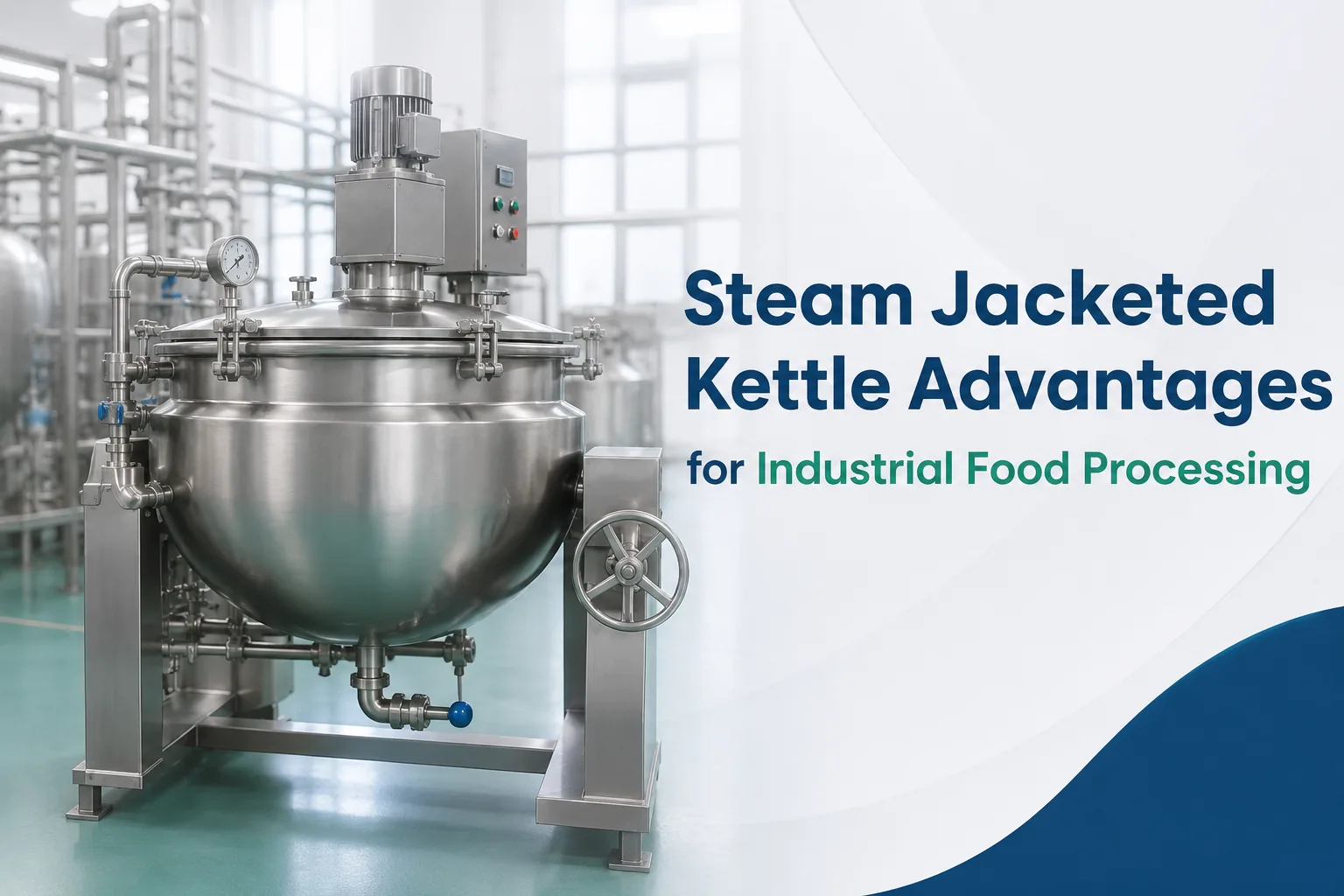
Exactly what is a steam jacketed kettle? It is basically a twin-wall vessel. A steam-jacketed kettle is a twin-wall vessel in which steam circulates through the jacket surrounding the inner vessel. Heat is transferred indirectly through the vessel wall to the product.
The product remains inside the vessel while steam enters the surrounding jacket. Heat passes through the vessel wall and raises the product temperature without direct steam contact.
This arrangement can provide controlled heating and reduce the risk of localised overheating when the equipment is correctly designed and operated.
Envitro Technomech manufactures steam jacketed kettle for industrial food processing and cooking.
The kettles can be configured with temperature controls, mixing systems, tilting arrangements, and application-specific construction.
How Does a Steam-Jacketed Kettle Work?
The steam jacketed kettle working process begins with introducing the ingredients into the vessel. Steam then enters the surrounding jacket.
Heat passes through the vessel wall and transfers to the product. Operators control the heating conditions according to the formulation and required processing temperature.
Where necessary, an agitator keeps the product moving. This can support more uniform heat distribution and consistency.
Actual operating conditions depend on the product, formulation, capacity, steam supply, and equipment design. For food businesses, appropriate control of processing conditions is also important for food safety.
Steam Jacketed Kettle Benefits
Steam-jacketed kettles offer several advantages for industrial food processing.
- Controlled heating
- Consistent batch processing
- Lower risk of localised scorching
- Flexible applications
- Easier release
- Hygienic construction
- Customised configuration
Explore your options.
Processing Applications
- Soups, gravies, and sauces
- Chutneys, jams, and jellies
- Syrups and beverages
- Dairy preparations
- Semi-liquid food products
- Pharmaceutical formulations
- Cosmetic creams and lotions
- Selected chemical mixing applications
Envitro Technomech also supplies fruit and vegetable processing plants, pulp plants, canning systems, evaporators, mixing tanks, and dairy processing machinery.
Explore customised processing setup.
Steam Jacketed Kettle Specifications
Match the following steam jacketed kettle specifications to the actual process rather than only to the vessel size.
Envitro Technomech lists the following specifications for its kettles:
| Parameter | Listed specification |
|---|---|
| Capacity | 100 to 1,000 litres |
| Product-contact material | SS 304 / SS 316 |
| Orientation | Vertical cylindrical |
| Vessel design | Dished top with flat or conical bottom |
| Internal finish | Mirror finish, ≤0.8 Ra |
| Heating | Half coil, dimple jacket, or full jacket |
| Operating temperature | Ambient to 120–150°C |
| Product-side pressure | Atmospheric |
| Agitator | Anchor, paddle, or scraper |
| Agitator speed | 20–60 RPM, VFD controlled |
| Motor rating | 1–20 HP |
| Insulation | PUF or glass wool with SS cladding |
| Condensate outlet | Bottom jacket drains with steam trap |
Steam Jacketed Kettle and Direct Heating Comparison
| Factor | Steam Jacketed Kettle | Direct Heating |
|---|---|---|
| Heat transfer | Through vessel wall | Direct heat source |
| Steam contact | No direct product contact | Depends on method |
| Temperature control | Generally controlled | Depends on system |
| Hot-spot management | Can be better with suitable design | Can vary by method |
| Product suitability | Many liquid and semi-liquid products | Depends on heating method |
| Customisation | Jacket, agitator, controls, discharge | Depends on heater design |
What Should You Check Before Buying?
Before selecting a kettle, assess the required batch capacity and product characteristics. Viscosity, agitation, temperature ranges, and process time requirements may affect kettle design.
Suppliers should also be asked about available steam capacities, materials, discharge options, cleanability, insulation, footprint, maintenance, and support services. Discuss your processing requirements with Envitro Technomech.
Conclusion
A jacketed kettle is a versatile, hygienic, and reliable equipment that offers good control of the heating process and can accommodate a wide range of viscosities. Understanding the advantages of a steam-jacketed kettle can help manufacturers select equipment that best suits their production requirements.
Visit Envitro Technomech for customized kettle solutions alongside food processing machinery for different production requirements.
Also Read: How to Choose Between a Small and Industrial Food Processing Plant
FAQs
Q1. What Should Users Consider While Selecting a Steam Jacketed Kettle?
Ans: Factors for consideration include size, viscosity, materials, heating agitation, temperature control, handling and process requirements.
Q2. Is Stainless Steel a Good Choice for a Food Processing Kettle?
Ans: Stainless steel is corrosion- and hygienic-resistant, making it suitable for food-processing kettles.
Q3. Do I Need an Agitator?
Ans: It depends on the type of product. Highly viscous products may require a suitably designed agitator to ensure it is well-mixed and heated. Anchor, paddle, and scraper agitators are common in jacketed kettles.
Q4. What Types of Food Products Can Be Processed in a Steam-jacketed Kettle?
Ans: Steam-jacketed kettles can process soups, sauces, gravies, jams, chutneys, syrups, dairy preparations, and other suitable liquid or semi-liquid products.
Q5. How Does a Steam-jacketed Kettle Help Prevent Scorching?
Ans: Indirect heating through the vessel wall helps reduce localized hot spots and the risk of scorching when properly designed and operated.
Q6. Can a Steam-jacketed Kettle Be Customised?
Ans: Yes, kettles can be customised based on capacity, material, heating system, agitator, temperature controls, discharge, and other production requirements.