
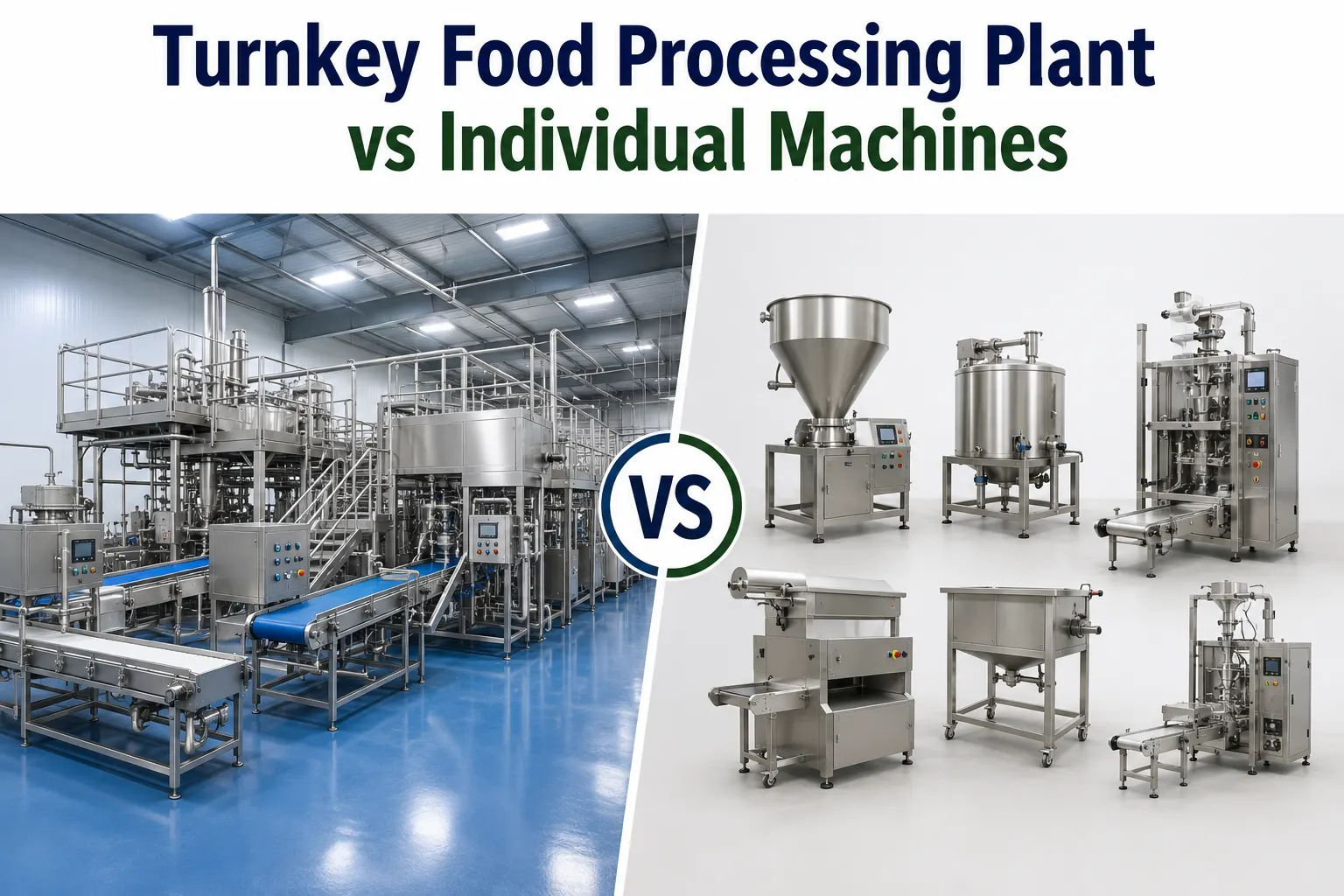
Key Takeaways
- Turnkey food processing plants provide a complete, integrated production solution with design, manufacturing, installation, automation, and commissioning managed by a single supplier.
- Individual machines offer greater flexibility and lower upfront investment, making them suitable for startups, pilot projects, and businesses expanding production gradually.
- Turnkey plants improve system integration, automation, production efficiency, and faster project execution, helping reduce long-term operational costs.
- Purchasing individual machines allows businesses to upgrade equipment step by step, but may create integration challenges, longer commissioning times, and higher coordination costs.
- Your decision should consider production capacity, budget, factory layout, automation requirements, product range, and future expansion plans.
- Large-scale manufacturers, exporters, dairy processors, and ready-to-eat food producers generally benefit more from turnkey processing plants, while small businesses often gain more value from individual machines.
- Partnering with an experienced food processing equipment manufacturer helps ensure reliable system performance, food safety compliance, and long-term return on investment (ROI).
Introduction
Choosing the right equipment between a turnkey food processing plant and individual machines is important for your food business. Whether you are going to launch your new production facility or expand your existing business, you must choose the right machine type for your industrial needs. Both options provide you with unique benefits, but the best investment depends on your production goals, budget, growth plans, and operational requirements.
A turnkey solution provides you with the integrated production line for operation, whereas the individual machines allow you to build or upgrade your processing systems gradually.
You must understand the difference between both machine types to increase efficiency, control costs and achieve consistent product quality. In this blog, we compare turnkey food processing plants vs individual machines and help you make the right decision for your food business.
Turnkey Food Processing Plant
A turnkey food processing plant is a ready-to-operate manufacturing facility where a single expert handles the entire project lifecycle. It consists of the equipment sourcing, initial design, installation, and final supply, and allows the client to simply “turn the key” and start production. Its pros and cons are given below.
The Pros
- Seamless Integration
All machines, conveyors, and packaging lines are designed to work together smoothly and prevent issues with mismatched throughput.
- Single Point of Accountability
While running the turnkey plants, the vendor takes care of troubleshooting and maintenance, so there is no blame game when something goes wrong.
- Faster Commissioning
Projects usually go into commercial operation up to 50% faster than when coordinating multiple vendors.
The Cons
- Higher Upfront Cost
Its initial costs range between 20% to 40%. It is a higher cost than self-managed builds, but better integration often results in lower long-term costs.
- Less Flexibility
These plants have less flexibility and allow you to only stick to a specific system design. It makes it challenging to replace proprietary parts from different vendors later.
Individual Machines
Buying individual equipment from various manufacturers allows you to build or upgrade a production line step by step. Its pros and cons are given below.
The Pros
- Lower Initial Capital
The individual Machines are suitable for small or startup units looking to expand gradually. You can focus on specific bottlenecks without needing to buy a whole new line.
- Best Approach
You can choose the best washer, cooker, or packaging machine for your specific needs.
The Cons
- Integration Hassles
Integrating the mechanical and digital systems from several suppliers is complicated and may lead to bottlenecks.
- Finger-Pointing
When sensors fail or throughput slows, vendors usually blame each other for the incompatibility.
- Hidden Costs
It is costly to manage the multiple electrical setups, custom plumbing, and different warranties. It costs overruns of 15% to 25% and causes industrial hassles.
Detailed Comparison of Turnkey Food Processing Plant vs Individual Machines
A turnkey food processing plant is an end-to-end production line designed by one expert provider, guiding your project from initial concept to a ready-to-run facility. On the other hand, buying individual machines means you independently find, connect, and manage separate pieces of equipment. Here is the detailed comparison guide on Turnkey Food Processing Plant vs Individual Machines
1. Project Management & Accountability
- Turnkey Plant
In turnkey plants, you need to sign one contract with a single provider who can manage the entire project lifecycle. It includes the single provider who manages facility layout, machinery installation, automation programming, trial runs, and staff training.
- Individual Machines
In the case of individual machines, you play the role of the system integrator. You are responsible to coordinate multiple vendors, and ensure that the mechanical and electrical systems work together and manage the installation.
2. Efficiency & Integration
- Turnkey Plant
All machines and software in turnkey plants, like PLC or SCADA systems, are intentionally selected and synced by the vendor to work seamlessly together and eliminate bottlenecks.
- Individual Machines
These machines are available from different manufacturers and increase the risk of mismatched speeds, incompatible operating systems, and issues with transferring materials between machines.
3. Compliance & Hygiene
- Turnkey Plant
Turnkey plants feature the proper sanitary pipework, hygienic zoning, and clean-in-place (CIP) systems and meet modern regulatory standards.
- Individual Machines
You need to ensure each unit, along with its specific fittings and connections, meets HACCP and ISO requirements.
4. Cost & Timelines
- Turnkey Plant: Higher initial investment, but it usually avoids costly design revisions, coordination failures, and construction delays.
- Individual Machines: Lower upfront costs make them flexible for small-scale production, pilot tests, or expanding existing operations. However, integration issues can significantly raise the final total cost.
Difference Between Turnkey Processing Plants and Individual Machines
A turnkey food processing plant is a suitable investment for scaling production and ensuring accountability from a single source. Individual machines are suitable for specialized products, but their gradual budget increases. Here are the key differences on Turnkey Food Processing Plant vs Individual Machines
| Feature | Turnkey Food Processing Plant | Individual Sourcing (Best-of-Breed) |
| Vendor Management | Single point of contact for all machinery and setup. | Multiple vendors to coordinate and contract. |
| Upfront Cost | Higher initial capital expenditure. | Lower initial cost; pay as you build. |
| System Integration | Guaranteed seamless matching of throughput and speed. | Risk of mismatched capacities and speed bottlenecks. |
| Engineering Responsibility | The supplier manages layout, piping, and software. | Your team manages mechanical and digital interfaces. |
| Time to Market | Faster deployment and streamlined commissioning. | Slower; prolonged troubleshooting during setup. |
| Floor Space Efficiency | Typically uses 25% to 35% less floor space. | Larger footprint due to unoptimized connections. |
Which Businesses Should Choose a Turnkey Plant?
Here are the types of businesses that can use the turnkey food processing plants
- Large-scale manufacturers
- Exporters
- Dairy processors
- Ready-to-eat food producers
- Beverage manufacturers
- Frozen food companies
- Entrepreneurs who establish new factories
These businesses can benefit from the faster setup, automation and operational efficiency.
Which Businesses Should Choose Individual Machines?
Individual machines are suitable for
- Small food processors
- Startups
- Businesses with limited budgets
- Companies that are expanding gradually
- Manufacturers are replacing outdated equipment
This approach provides flexibility and reduces the initial financial commitment.
Partner with Envitro Technomech for Complete Food Processing Solutions
Envitro Technomech specializes in the manufacturing of customized turnkey food processing plants and high-performance individual processing machines. We serve various industries with our Food Processing Machinery. Our every machine is designed for efficiency, reliability, food safety, and long-term productivity.
From concept and plant design to installation, commissioning, and after-sales support, our experienced team offers end-to-end solutions that help businesses streamline operations, improve product quality, and achieve sustainable growth with confidence.
Conclusion
There is no one-size-fits-all solution when comparing Turnkey Food Processing Plant vs Individual Machines. If you are seeking an integrated, efficient, and scalable production system, then Turnkey solutions are best for you.
It streamline project management and lasting operational benefits. If you need the flexible machines at low costs, then individual machines are best for you. It gives you flexibility to gradually expand production.
You should evaluate the production volume, budget, business goals, and future growth plans. You can choose the investment that delivers the best value and supports the long-term success of your food processing operation.
Also Read: Daily Maintenance Tips for Industrial Retort Machines
FAQs
Q1. What is a Turnkey Food Processing Plant?
Ans: A turnkey food processing plant is the complete production system that includes the machinery, automation, installation, and technical support. Every support is provided by a single manufacturer or supplier.
Q2. Are Individual Food Processing Machines Suitable for Small Businesses?
Ans: Yes, it is suitable for startups and small businesses because of the low initial investment required. It provides you with flexible expansion and allows you to upgrade equipment as the production demand rises.
Q3. Which Option Offers Better Long-term Value?
Ans: Turnkey plants provide better long-term value through integrated automation, high efficiency, less downtime, and consistent product quality.
Q4. Can a Turnkey Food Processing Plant Be Customized?
Ans: Yes, the turnkey food processing plants are customized as per your specific industrial requirements, production capacities, factory layouts, industry regulations, and automation requirements. It ensures optimal equipment efficiency and performance.
Q5. How Do I Choose the Right Food Processing Solution for My Business?
Ans: You must consider your production capacity, space, automation needs, regulation requirements, and budget to buy the right food processing machine.