
Key Takeaways
- Small food processing plants are ideal for startups, small businesses, and regional markets due to their lower investment, flexible production, and easier scalability.
- Industrial food processing plants are designed for high-volume manufacturing with advanced automation, consistent product quality, and large-scale distribution.
- Choosing the right plant depends on factors such as production capacity, budget, available space, automation requirements, product range, and long-term business goals.
- Small plants provide greater flexibility for testing new products and adapting to changing market demands, while industrial plants offer better efficiency and lower production costs at scale.
- Industrial facilities require higher capital investment and stricter compliance with food safety standards, but deliver greater productivity and long-term operational efficiency.
- Evaluating market demand, infrastructure requirements, labor availability, regulatory compliance, and future expansion plans helps businesses make the right investment decision.
- Partnering with an experienced food processing machinery manufacturer ensures the selection of scalable, reliable equipment that supports sustainable business growth.
Introduction
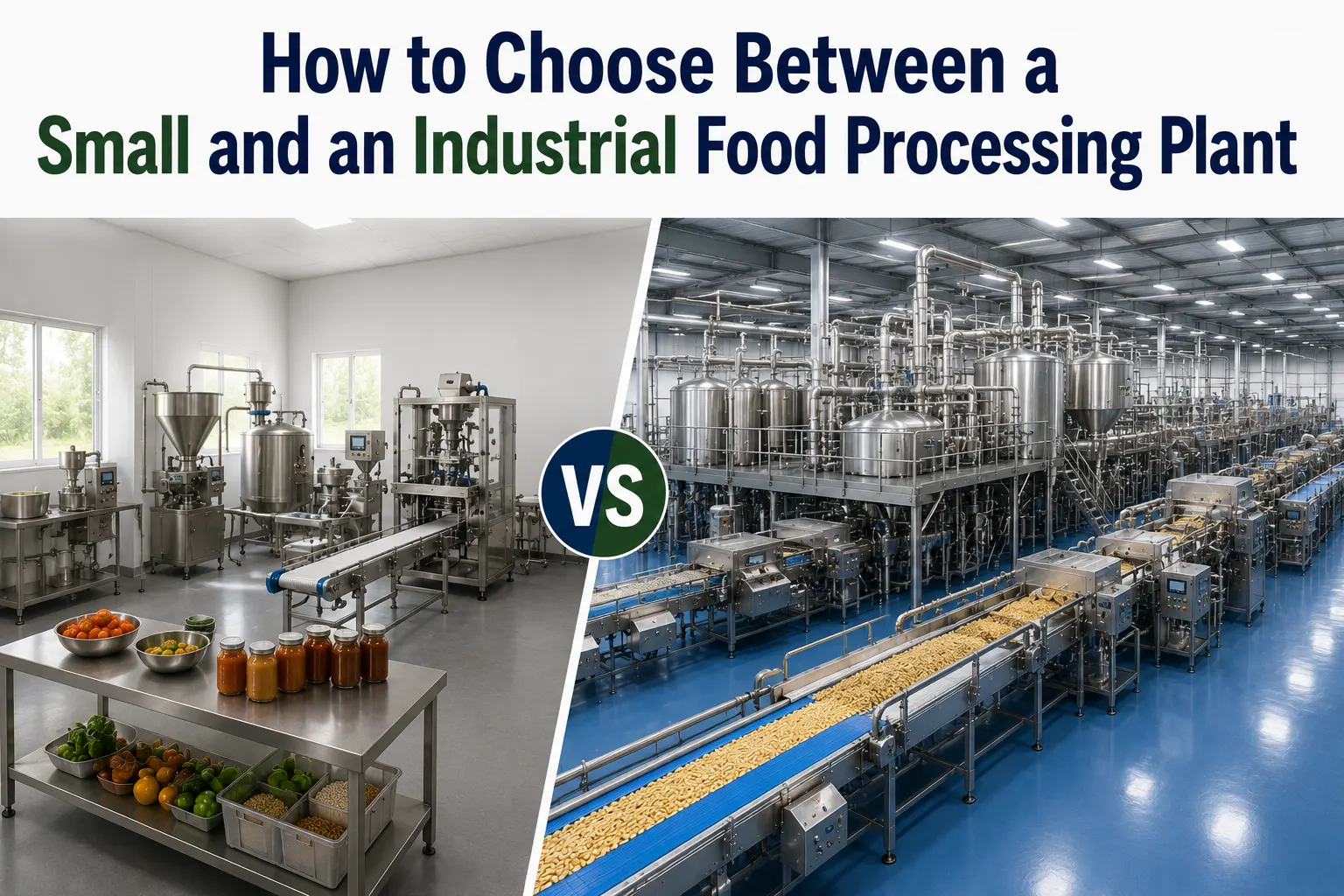
Small food processing plants are used to transform the raw materials into packaged and shelf-stable products on a small scale. An industrial food processing plant is a specialized facility where raw materials are transformed into consumable food on a large scale. Selecting the right plant is an important investment decision for your food business.
Whether you are a startup entering the market or an established company that wants to expand, you must choose between a small food processing plant and an industrial food processing plant to improve your production capacity, profitability, and operational efficiency.
Both options have unique benefits, but you must choose the right one on the basis of your budget, product range, production capacity, factory space, automation needs, and future business goals. In this blog, we tell you the differences between the small vs industrial food processing plants and factors that help you to choose the right option between both.
What Is a Small Food Processing Plant?
A small food processing plant is a facility that transforms raw agricultural ingredients into packaged, shelf-stable, or ready-to-eat products. It is designed for smaller batches and connects home kitchens with large industrial setups by using compact, flexible machinery. Usually, small plants are set up to produce the following types of products.
- Pickles
- Sauces
- Jams
- Bakery products
- Fruit pulp
- Spice processing
- Ready-to-cook foods
- Local dairy products
What Is an Industrial Food Processing Plant?
An industrial food processing plant is a manufacturing facility that transforms raw agricultural products into food in high volume. Such plants use advanced machinery, automated production lines, and strict hygiene protocols to ensure food safety, extend shelf life, and efficiently scale operations. Here are the products it processed
- Dairy Products Machinery Manufacturers
- Ready-to-eat meals
- Canned foods
- Frozen foods
- Snack foods
- Beverages
- Fruit and Vegetable Steam Peeler Machine
- Processed meat and seafood
Pros and Cons of a Small Food Processing Plant
Small processing plants are suitable for regional markets, artisan goods, or testing new products. Let us talk about its pros and cons below.
Pros
- Lower Capital Investment: Due to the low capital investment, it is easy to set up the small plants.
- High Agility: It allows you to easily change your product line, test niche markets, like organic or vegan, and align with customer preferences.
- Lower Operational Risk: It requires less physical footprint and a smaller workforce, control over the fixed overhead costs, and carries less operational risk for you.
Cons
- High Costs: It has higher production costs per unit than in mass production.
- Production Caps: Limits on output restrict expansion into large supermarket chains or export markets.
Pros and Cons of an Industrial Food Processing Plant
Industrial plants like large dairy or beverage facilities process the mass distribution and high volume output of food. Its advantages and drawbacks are given below.
Pros
- Affordable Costs, High Margins: It has lower per-unit costs and higher profit margins when running at full capacity.
- Consistency & Automation: This machinery ensures uniformity in batch and consistency in food taste, shape, and texture.
- Mass Market Reach: It is designed to handle mass production and serve national and international markets consistently.
Cons
- High Capital Requirement: It has high upfront and ongoing costs, approximately between ₹2 crores and ₹5 crores.
- Regulatory Complexity: Setting up the large automated hygiene stations and Food ERP systems requires strict compliance with regulations.
- Inflexibility: Because the large plant infrastructure is rigid, it is challenging to adapt quickly to changes in consumer trends.
Key Comparison of Small vs Industrial Food Processing Plant
Here is the detailed comparison of the small vs industrial food processing plants
| Feature | Small Food Processing Plant | Industrial Food Processing Plant |
| Suitable for | Niche markets, local distribution, or testing new food. | Wide distribution, Mass markets, and high-volume retail. |
| Production Style | Flexible batch mixing, manual/semi-automated setups. | Fully automated, continuous, high-precision lines. |
| Initial Capital | Low | Very high |
| Consistency | Vary according to batches | Highly precise |
| Regulatory Burden | Simpler local licenses | Strict international compliance is required (e.g., HACCP, FDA). |
Core Deciding Factors to Choose Between the Small and Industrial Food Processing Plants
To choose between the small vs industrial food processing plants, you must look at the market reach, capital, and operational flexibility. A small plant is ideal for local distribution, artisan branding, and lower startup costs. An industrial plant is ideal for mass market production, high-volume efficiency, and extensive automation. Here are the key factors you should evaluate
1. Market Demand and Production Volume
Small plants process the limited batches of food and serve local or direct-to-consumer markets. Industrial plants work with high-speed automated lines, enabling mass production and ensuring regional or national distribution.
2. Capital Investment
Running the small plant requires lower upfront capital for equipment and facilities, but industrial plants require large investments in automated processing, packaging machinery, and facility construction.
3. Regulatory Compliance
Small plants usually deal with local or state health departments with less complex licensing. On the other hand, Industrial plants require strict national or international standards and involve quality control labs and certifications.
4. Operational Flexibility
Small food processing plants handle the quick adjustments, seasonal shifts, and product changes. But Industrial plants are only designed for continuous runs of identical products, and making changes and upgrades costly and time-consuming.
5. Labor & Automation
manual or semi-automated labor work at small food processing plants, and keep initial costs low but rise with scaling. But the Industrial plants use automation, like robotics and Clean-in-Place systems, and reduce labor costs.
6. Infrastructure & Utility Needs
Small plants can often work in retrofitted commercial kitchens. Industrial plants need dedicated, heavy-duty infrastructure, including industrial power supplies, high-capacity water treatment, and large cold-storage spaces.
Find the Right Food Processing Plant with Envitro Technomech
Trust Envitro Technomech to buy the right food processing machines for your startups or large industrial plant expansion. Our suppliers supply you with customized solutions as per your industrial requirements and production goals.
Our food processing equipment is designed for efficiency, reliability, and long-term performance. We assist businesses with planning, equipment selection, installation, commissioning, and technical support to create scalable, cost-effective processing facilities that ensure consistent product quality and sustainable growth.
Conclusion
The right option between the small vs industrial food processing plants depends on production capacity, budget, product range, factory space, automation needs, and long-term growth plans. Small plants are suitable for startups and businesses with limited production needs.
On the other hand, Industrial plants provide the efficiency, scalability, and automation needed for large-scale manufacturing. By assessing your operational requirements and future goals, you can choose a food processing solution that maximizes productivity, maintains product quality, and supports business growth.
Read Also: Hidden Costs in Food Processing Plants That Reduce Your Profit Margins
FAQs
Q1. What is the Difference Between a Small and an Industrial Food Processing Plant?
Ans: Its difference lies in the production volume, automation level, and batch consistency. Small plants involve manual labor and batch processing, while industrial plants use automated lines and continuous systems and ensure uniform and high-speed output.
Q2. Which Food Processing Plant is Better for Startups?
Ans: For startups, small food processing plants are better because of less capital requirements. It supports your agile product testing setup and adheres to the local regulatory licenses, like FSSAI registrations in India.
Q3. Can I Upgrade the Small Food Processing Plant?
Ans: Yes, you can upgrade the small food processing plant later. You can easily scale up as per your capacity requirements and handle production demands.
Q4. What Should I Consider Before Choosing a Food Processing Plant?
Ans: You should consider some crucial factors like manufacturing capability, food safety compliance, facility location, cost, and sustainability to choose the right food processing plants.
Q5. How Does Food Safety Compliance Differ in Small vs Industrial Plants?
Ans: Both types of plants adhere to the food safety regulations (such as FSSAI guidelines in India). Small plants rely on manual monitoring and routine testing, whereas industrial plants undergo audited, automated compliance checks like CIP ( Clean in Place protocols).