
Key Takeaways
- Retort processing uses high temperatures (116°C–130°C) and pressure to achieve commercial sterilization, making foods shelf-stable without refrigeration.
- Pasteurization uses lower temperatures (typically 60°C–82°C) to reduce harmful microorganisms while preserving freshness, but refrigerated storage is required.
- Retort processing is ideal for ready-to-eat meals, canned foods, soups, curries, seafood, and other shelf-stable products.
- Pasteurization is best suited for milk, dairy products, juices, beer, yogurt, and other refrigerated beverages.
- The choice between retort processing and pasteurization depends on your product type, desired shelf life, packaging, distribution method, and food safety requirements.
- Manufacturers targeting long-distance distribution or export markets often prefer retort processing due to its extended shelf life and reduced cold-chain dependence.
- Selecting the right preservation method helps improve product safety, operational efficiency, and overall production costs.
Introduction
Food preservation is an important matter to keep the food safe, nutritious, and fresh for consumers. There are various preservation methods used, including retort processing and pasteurization. Both are two different techniques used in the food and beverage industry. Even though both methods use heat to eliminate harmful microorganisms, they differ in processing methods, shelf life, temperature, packaging requirements, and applications.
You must understand the difference between retort processing and pasteurization to choose the suitable preservation technology for your food products. In this blog, we compare retort processing vs pasteurization and explain how each method works, highlight the benefits, and help you determine which solution is best for your requirements.
What is Retort Processing?
Retort processing is a high-pressure, high-temperature food preservation method that achieves complete commercial sterility. It eliminates harmful pathogens and heat-resistant bacterial spores, allowing food to be safely stored at room temperature for years without refrigeration.
That is why leading food retort machine manufacturers design advanced retort systems to deliver consistent sterilization, product safety, and extended shelf life.
What is Pasteurization?
Pasteurization is a low-temperature and mild heat treatment that reduces the microbial load. It kills the active pathogens but leaves some harmless or heat-resistant bacteria and spores intact. The pasteurized products have a shorter shelf life and require refrigeration.
Pasteurization uses temperatures between 145°F and 280°F (63°C to 138°C), on the basis of the method. There are a few common variations.
- Vat pasteurization (low-temperature, long-time): Heat food to about 145°F for 30 minutes.
- High-temperature, short-time (HTST): Heat food to about 161°F for 15 seconds, and use it for milk.
- Ultra-high temperature (UHT): Heat food to about 280°F for some seconds, and allow milk to be shelf-stable without refrigeration until opened.
Pasteurization does not eliminate all microorganisms, especially heat-resistant spores. As a trusted Juice pasteurization machine Manufacturer, we design systems that effectively reduce harmful microorganisms while preserving product quality. Pasteurized products still require refrigeration and have a limited shelf life, typically measured in days or weeks.
How Does Pasteurization Work?
Pasteurization requires heating food for a short period at a low temperature. The process usually includes the
- Product preparation
- Controlled heating
- Holding at target temperature
- Fast cooling
- Refrigerated storage
Because Pasteurization does not eliminate all microorganisms, maintaining refrigeration after processing is important for product safety.
How Does Retort Processing Work?
Retort processing involves the following stages carefully
1. Product Preparation
The food is prepared, cooked if needed, and packed into containers that can be sterilized.
2. Sealing
Packages are tightly sealed to avoid contamination during and after processing.
3. Heating
The sealed products are placed in the retort chamber, where steam, hot water spray, or water immersion heats them to sterilization temperatures.
4. Holding Time
Products stay at the required temperature long enough to eliminate harmful microorganisms and bacterial spores.
5. Cooling
After sterilization, the packages are cooled under controlled conditions. They are then inspected, labeled, and stored.
Detailed Differences between Retort Processing and Pasteurization
Here are the differences between Retort Processing vs Pasteurization
1. Temperature & Pressure
Retort Processing: It is used to heat the food up to temperatures between 116°C and 130°C (240-265°F). This exceeds the boiling point of water, so pressure is used inside a machine (autoclave) to keep the packaging from bursting.
Pasteurization: Through this method, products are heated to much lower temperatures, between 60°C and 100°C (140-212°F). No extreme pressure is required.
2. Microbial Destruction
Retort Processing: It destroys all living pathogens and heat-resistant spores and achieves “commercial sterility”.
Pasteurization: This process kills the common living pathogens, yeasts, and molds but leaves heat-resistant bacterial spores intact.
3. Shelf Life & Storage
Retort Processing: Retort processing has a long shelf life (often 12-36 months at room temperature) and can store food. It does not require preservatives or refrigeration until opened.
Pasteurization: It requires continuous refrigeration (often below 4°C) to stop the surviving bacteria from multiplying and results in a shorter shelf life.
4. Taste, Texture, and Nutrition
Retort Processing: Because of the high heat and longer cooking times, the food’s texture, color, and flavor can sometimes suffer. Heat-sensitive vitamins may also decrease.
Pasteurization: The milder heat better preserves the original color, texture, and flavor of the food, though some delicate flavors (like those in fruit juices) can be lost.
5. Common Applications
Retort Processing: The retort processing machines are used for low-acid, solid, or mixed foods like soups, stews, beans, meats, and ready-to-eat meals packed in cans, jars, or retort pouches.
Pasteurization: These machines are used for liquids and sensitive foods like milk, dairy products, juices, beer, and wine.
Retort Processing vs. Pasteurization: A Comparison Guide
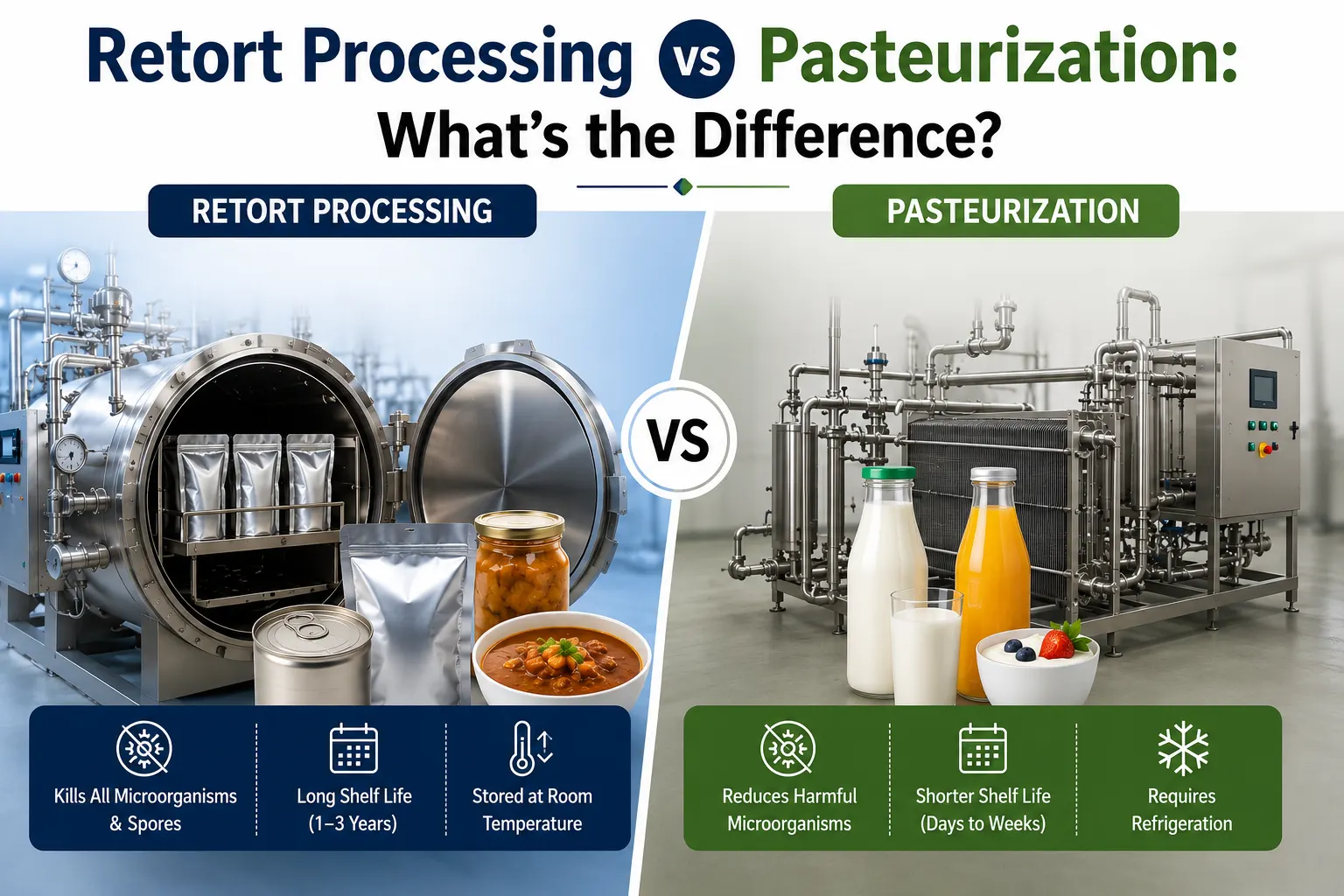
Pasteurization uses milder heat (usually 60°C-82°C) to kill the bacteria and increase the shelf life, but requires continuous refrigeration. Retort processing is a commercial sterilization method using extreme heat and pressure (116°C-130°C) to kill all microorganisms and spores, allowing for long-term storage at room temperature. The choice of method affects the shelf stability and quality of the final product. Let us look at the comparison of Retort Processing vs Pasteurization below.
| Feature | Pasteurization | Retort Processing |
| Temperatures Used | 60°C – 82°C (Milder heat) | 116°C – 130°C (High heat & pressure) |
| Microbial Target | Reduces target pathogens | Eliminates all microorganisms and spores |
| Shelf Life | Short ( from days to weeks) | Long (1–3 years) |
| Storage Requirements | Refrigeration required | Ambient / Room temperature |
| Typical Applications | Milk, liquid eggs, beer, juices, yogurt | Canned goods, ready-to-eat meals, military rations, and soups |
| Package / Process | It can be done before or after packaging | It can be done after the product is hermetically sealed |
Which Method is Better?
Neither method, retort processing or pasteurization is better. The right choice depends on your business goals and product.
You can choose the retort processing if you need
- Shelf-stable foods
- Long storage life
- Products ready for export
- Commercial sterilization
- Lower refrigeration costs
You can choose pasteurization if you need
- Fresh flavor
- Dairy processing
- Refrigerated products
- Short distribution chains
- Fresh beverages
Many food manufacturers use both methods for different product categories in the same facility.
Choose Envitro Technomech for Reliable Food Processing Solutions
Envitro Technomech is a reliable food processing manufacturer in India. We provide you with effective and innovative equipment tailored to your production needs. Our machines ensure consistent product quality, maximum food safety, energy efficiency, and compliance with safety standards.
With our years of experience in food processing technology, we help manufacturers increase productivity, extend shelf life, and achieve reliable results through customized and efficient equipment.
Conclusion
Both Retort Processing vs Pasteurization methods are used to keep food safer under specific heat, but work differently. Pasteurization is gentler and reduces pathogens for refrigerated, shorter-shelf-life products and preserves the food’s original qualities.
Retort processing is a more intense treatment that achieves commercial sterility in a sealed container, allowing for the long shelf stability we expect in canned goods and pantry staples.
Also Read: How to Set Up a Fruit Juice Processing Plant in India
FAQs
Q1. What is the Difference Between Retort Processing and Pasteurization?
Ans: Retort processing and pasteurization are different in terms of temperature. Retort processing uses higher temperatures to achieve longer shelf life and commercial sterilization. Pasteurization requires refrigerated storage and uses low temperatures to reduce harmful microorganisms.
Q2. Does Retort Processing Require Refrigeration?
Ans: No, it doesn’t require refrigeration. Properly retort-processed and sealed foods can be kept at room temperature till opened. It makes it suitable for long-term storage and transportation.
Q3. Which Foods Are Commonly Processed Using Retort Technology?
Ans: Retort processing is used for canned vegetables, soups, ready-to-eat meals, seafood, curries, meat products, pet food, baby food, and other shelf-stable packaged foods.
Q4. Why Do Pasteurized Foods Have a Shorter Shelf Life?
Ans: Pasteurization does not eliminate the bacterial spores. It means the products need continuous refrigeration to avoid microbial growth and ensure safety. It leads to a shorter shelf life than retort-processed foods.
Q5. How to Choose Between Retort Processing and Pasteurization?
Ans: Your choice between retort processing and pasteurization depends on your product, packaging, desired shelf life, distribution method, and food safety needs. Retort processing is suitable for shelf-stable products, and pasteurization is suitable for fresh products.