
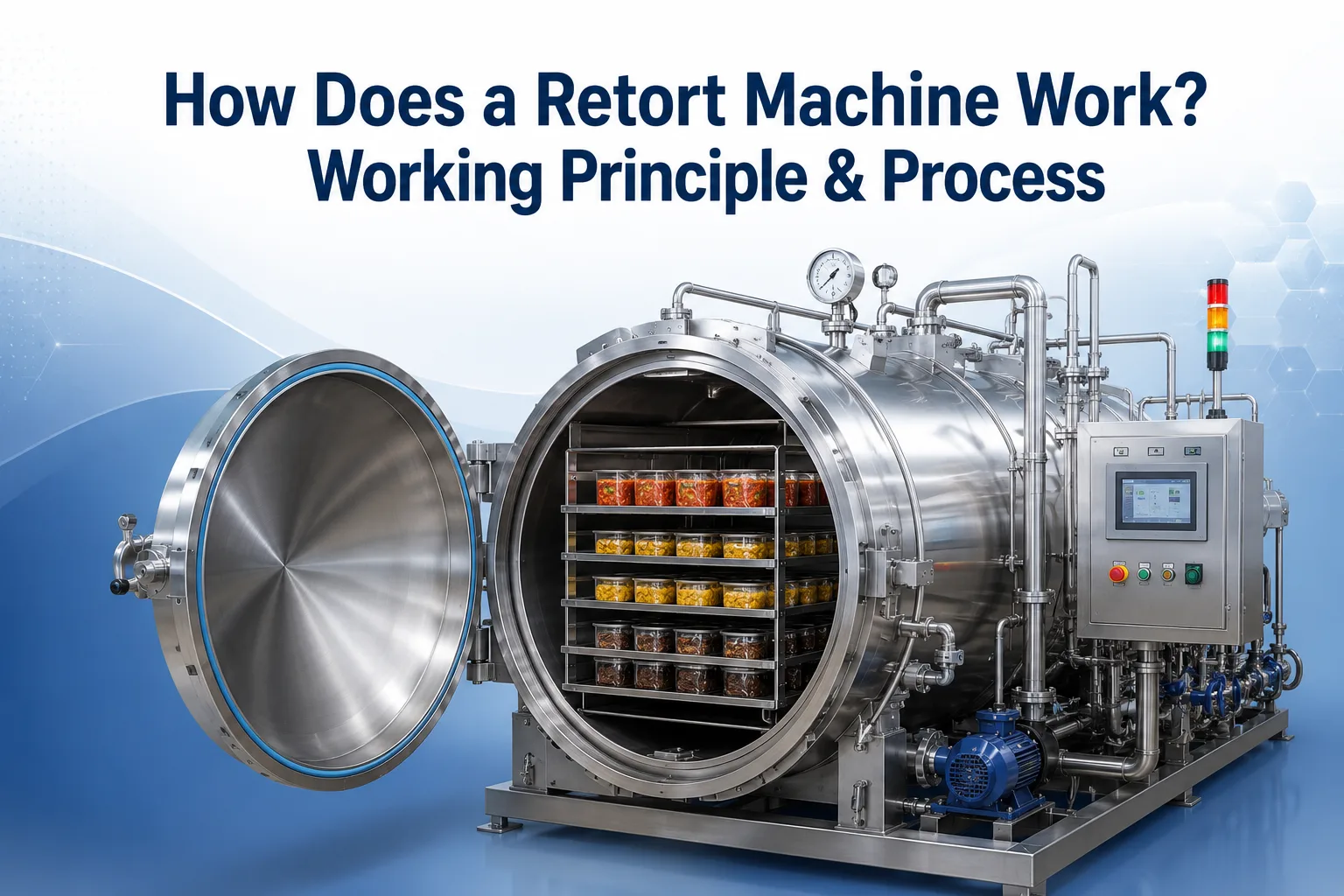
Food manufacturers must make their products safe and shelf stable packaged food. A retort machine helps them with that by utilizing heat under pressure to sterilise food packed in an airtight container safely.
Understanding the retort machine working principle helps manufacturers assess processing needs, packaging compatibility and equipment specifications.
What Is a Retort Machine?
A retort machine is a pressure vessel used for thermal processing of sealed food products. The item is placed in a pressurised vessel where steam, water or even water spray can be used to achieve the desired outcome. In technical terms, they are processing machines that heat sealable bags under pressure.
Those interested in developing such a unit or a system should keep their product specifications and retort machine working processes in mind.
Need long-term storage with an extended shelf life after processing? Explore how retort processing equipment can help you achieve your objective.
How Does a Retort Machine Work?
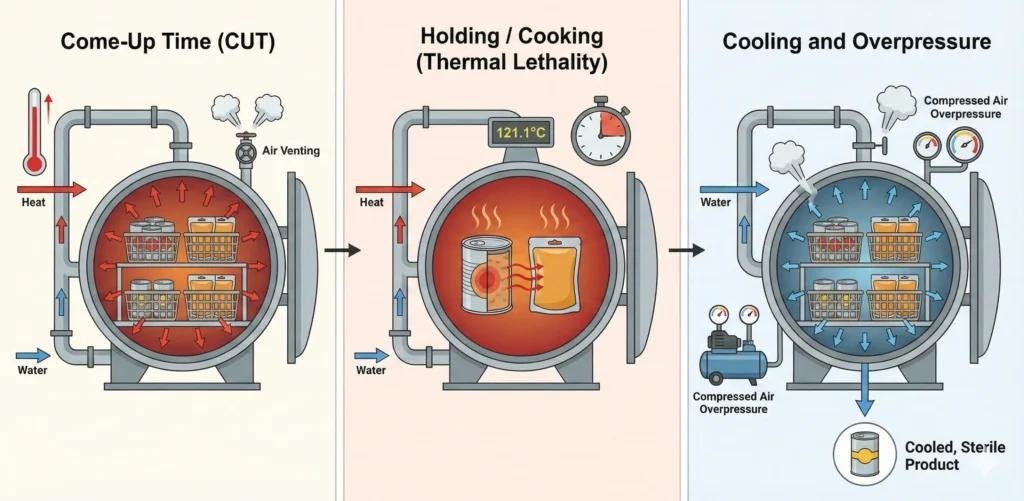
- Loading: The packing materials like trays, cans, pouches, or even jars are put into the baskets. It is crucial always to put the containers in the appropriate positions so that even heat distribution helps avoid damaging them.
- Sterilising: Most commercial retort equipment uses temperatures between 116 to 1210C, but conditions may vary. It should meet other target specifications according to the product and package. The machine should continue heating until it reaches the desired process value.
- Holding: This refers to keeping the food product at a specific pressure or temperature to prolong its shelf life. At this level, the heat should penetrate through the material so that all microorganisms capable of spoiling or contaminating the food item are destroyed. The duration needed to achieve this depends on the package’s size as well as the nature of the food being processed.
- Cooling: After the required treatment, the product is cooled under controlled conditions. Pressure management is crucial at this stage because changes may damage seals or deform the package.
- Unloading: After completing the cycle, the packages are removed and sent for inspection, labelling, secondary packaging and storage.
The entire retort machine working process needs following the correct procedures with strict control.
Learn the mechanisms involved in a retort machine.
Applications of Retort Processing
| Retort type | Working method | Suitable applications |
| Static retort | Product remains stationary | Canned foods, sauces and packaged foods |
| Rotary retort | Containers rotate or move during processing | Products where agitation improves heat transfer |
| Hydrostatic retort | Uses water columns for pressure control | High-volume continuous processing |
Based on the product requirement, these machines can be applied in processing the following products:
- Most ready-to-eat meals are suitable for static or even rotary retort processing.
- Canned vegetables are usually packed with static equipment.
- Sauces, gravy, soup, curry pulses, meat & fish meals, baby food, pet foods or even other food products are typically suitable for either static or Retort Machine.
Benefits of Retort Processing Machine
A retort machine enhances consistency as most modern machines allow automated regulation of pressure, heat, and temperature control among other aspects. Some other benefits of using retort processing include:
- Commercial sterility to enhance the shelf life of packaged foods
- Improving food security since they prevent spoilage
- Flexibility in packaging because the system allows different material
- Maintain production continuity and meet customer experience
Retort Machine Specifications to Consider
- Capacity
- Temperature range
- Pressure control
- Package type
- Automation
- Material
- Safety systems
- After-sales support
Comparing Retort & Pasteurisation Processing
Factor Retort processing Pasteurisation
Typical use Shelf-stable packaged foods Refrigerated or less severely processed products
Packaging Sealed before processing Varies by product
Refrigeration May not be required Often required
Typical products Ready meals, canned foods Milk, juices and beverages
Conclusion
Every equipment functions under a specific working principle and retort machine working processes are not an exemption. The basic idea is to deliver heat efficiently so that it can achieve the intended purpose of processing. Envitro Technomech provides retort processing equipment alongside food-processing machinery and complete processing solutions to support most product, capacity and process configuration.
Ready to plan your retort processing line? Discuss your product, packaging and production requirements with us today.
Also Read: Steam Jacketed Kettle vs Electric Kettle: Which Is Better for Food Processing?
FAQs
Q1. How Do Static and Rotary Retorts Differ?
In the former, the packages remain in a fixed position throughout the process. On the other hand, those using the latter experience rotational movement as an essential aspect.
Q2. Is Retort Processing Appropriate for Processing Ready-to-eat Food Items?
Yes, this form of processing is appropriate for preparing ready-to-eat items since there are numerous packaging options as well as flexible processing systems.
Q3. How Do I Determine Which Machine is the Best?
Some of the vital considerations when choosing this equipment or process include identifying the kind of product one intends to use, the target packaging option, the expected capacity requirement, the targeted method, the level of automation that one seeks along with after-sales support.