
Key Takeaways
- Thermal food processing uses controlled heat to destroy harmful microorganisms, deactivate enzymes, and extend shelf life.
- Non-thermal food processing uses technologies such as high-pressure processing (HPP), pulsed electric fields (PEF), ultrasound, irradiation, and cold plasma.
- Thermal processing offers reliable microbial control, established technology, and cost-effective solutions for mass production.
- Non-thermal processing can better preserve heat-sensitive nutrients, natural flavour, colour, and fresh-like texture.
- Thermal methods may affect food quality through nutrient loss, browning, and texture changes.
- Non-thermal processing often requires higher initial equipment investment and may need refrigeration or complementary preservation methods.
- The best processing method depends on food safety requirements, product quality, shelf-life goals, operating costs, and storage conditions.
Introduction
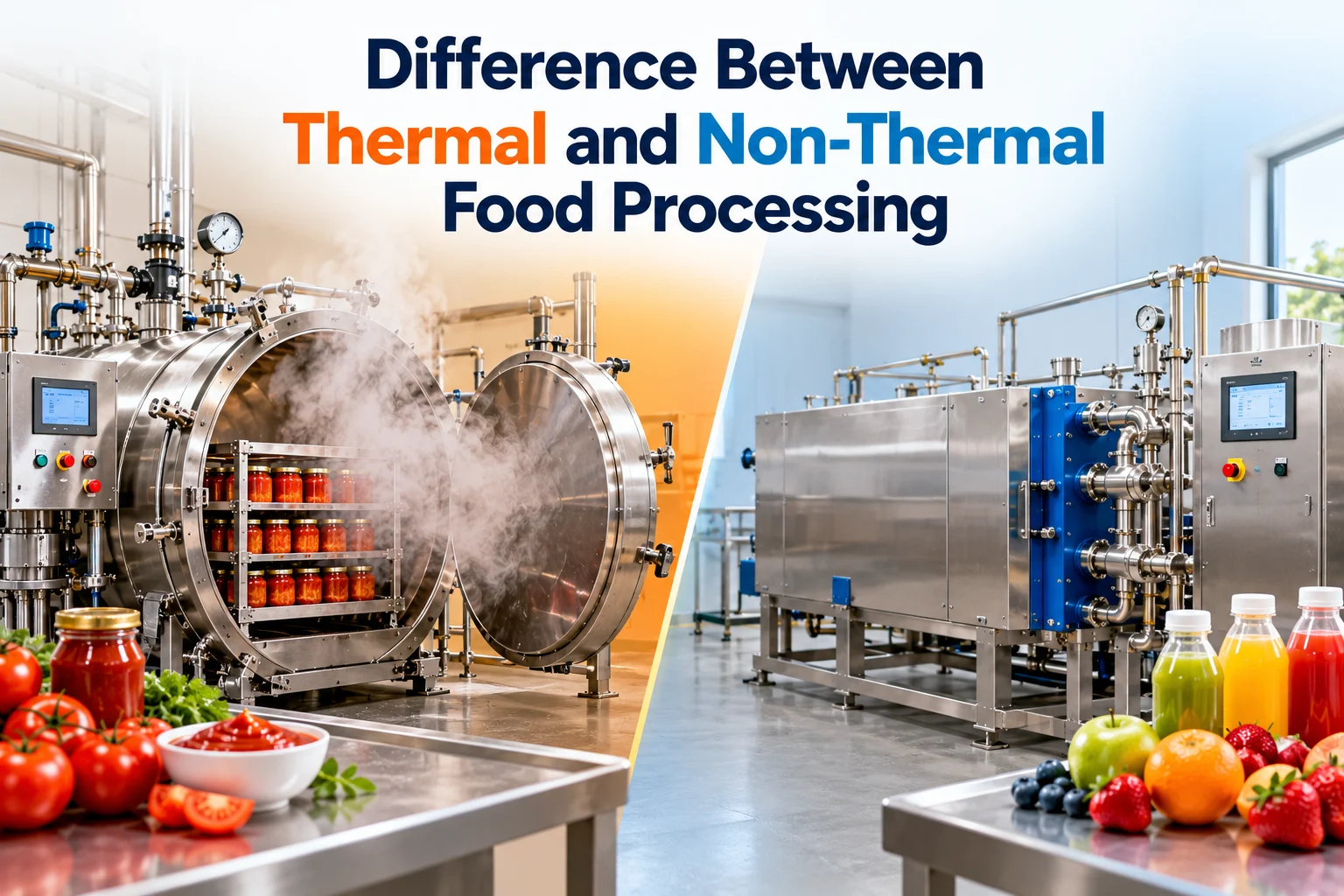
Thermal and Non-Thermal Food Processing are popular food processing technologies that can improve food safety, extend shelf life, maintain product quality and reduce spoilage. The main difference between thermal and non-thermal processes lies in the mechanism used to control microorganisms and extend shelf life.
Thermal processing relies on heat energy, and non-thermal processing methods use high pressure, electrical pulses, radiation, and sound waves to maintain food quality. Both methods have unique benefits, drawbacks and applications based on the food product and preservation requirements.
What Is Thermal Food Processing?
Thermal food processing is a controlled food preservation method that applies heat to food products for a specific duration and temperature combination. It can physically destroy harmful microorganisms, deactivate spoilage enzymes, and improve food safety. It can also extend the shelf life and improve the physical or chemical structure of the food to meet the quality and taste standards.
Common Thermal Food Processing Methods
Thermal food processing uses controlled amounts of heat and time to destroy harmful microorganisms. It can deactivate the enzymes that reduce quality and increase the shelf life. Here are the common thermal food processing methods used
1. Blanching
- Temperature/Time
1 to 2 minutes at a temperature ranging from 70°C to 100°C by hot water or steam.
- Purpose
It is used as a pre-treatment for fruits and vegetables before drying, freezing, or canning to deactivate enzymes that may cause browning and the loss of flavour or texture.
2. Pasteurization
- Temperature/Time
Apply mild heat (generally in the range of 60°C to 85°C, or at higher temperatures using HTST/UHT) for a specific period.
- Purpose
It is used to destroy disease-causing pathogens and the organisms that cause spoilage in liquids such as milk, juices, and soups, without affecting the sensory and nutritional properties.
3. Sterilization (Commercial Sterilization)
- Temperature/Time
The use of high heat (110°C to 130°C or higher) is achieved by autoclaving or by processing within the package.
- Purpose
This method is used to remove all vegetative microorganisms and heat-resistant spores (for example, Clostridium botulinum) and produces shelf-stable canned and bottled foods. It can extend the food shelf life for several years without the need for refrigeration.
4. Retort Processing
Retort processing is a thermal food preservation method that uses controlled heat and pressure to sterilize food inside sealed containers, such as cans, jars, and retort pouches. It helps destroy harmful microorganisms and achieve commercial sterility when the appropriate processing conditions are applied.
A retort machine is used to process packaged foods such as ready-to-eat meals, canned vegetables, soups, and sauces. This method helps extend shelf life and allows suitable products to be stored without refrigeration when processed, packaged, and stored under validated conditions.
5. Ultra-High Temperature (UHT)
- Temperature/Time
The temperature/time should be set at 135°C to 150°C for 1 to 2 seconds in a continuous flow system, and then the product should be packaged aseptically.
- Purpose
It enables the quick sterilization of liquid foods such as milk and cream and reduces the damage caused by heat to both flavour and nutrients.
6. Cooking, Baking, Roasting, and Frying
- Temperature/Time
The temperature and time required vary greatly according to the type of food and the energy source used (such as hot air, hot oil, or direct radiation).
- Purpose
This method transforms raw ingredients into palatable, safe-to-eat meals, improves digestibility, and reduces anti-nutritional factors.
What Is Non-Thermal Food Processing?
Non-thermal food processing is the method that inactivates harmful microorganisms and preserves food at room or near-ambient temperatures. These methods preserve the heat-sensitive nutrients, natural colours, textures, and the fresh taste that are usually destroyed by conventional cooking or heating.
Common Non-Thermal Processing Techniques
Non-thermal food processing methods can use these technologies to reduce microbial contamination, maintain food quality and extend shelf life. They maintain the natural flavor, texture, color, and heat-sensitive nutrients and support different food processing requirements. The common Non-thermal food processing methods used are
1. High Hydrostatic Pressure (HPP/HHP)
The packaged food is placed into a chamber filled with water at high pressure (usually between 200 and 600 MPa) and destroys the bacterial cell structures without the use of heat.
2. Pulsed Electric Fields (PEF)
It applies short bursts of high voltage (ranging from 20 to 85 kV/cm) to liquids or semi-solids such as foods and creates holes in the cell membranes of microorganisms.
3. Ultrasonication
This method involves using high-frequency sound waves (in the range of 20 kHz to 100 kHz) to produce microscopic bubbles. The bubbles then collapse and destroy microorganisms and support the extraction of valuable compounds.
4. Cold Plasma
In this method, the Ionized gas is applied at low temperatures (25°C–65°C) to produce reactive species which oxidize and destroy the pathogens on the food surface.
5. Irradiation
This method involves passing gamma rays, X-rays, or electron beams through food to directly damage the DNA of microorganisms.
6. Pulsed Light and UV Radiation
It uses brief bursts of intense light or ultraviolet-C rays to sanitize the surfaces of foods and packaging.
Difference Between Thermal and Non-Thermal Food Processing
Thermal food processing uses heat to destroy microbes and enzymes, whereas non-thermal food processing keeps food at ambient or low temperatures by using pressure, electric fields, light, or sound waves. Here are the key differences between thermal and non-thermal processes
| Feature | Thermal Food Processing | Non-Thermal Food Processing |
| Core Principle | Uses low or high temperatures to inactivate enzymes and microorganisms. | Uses light, electromagnetic, mechanical, or electric energy without high heat. |
| Operating Temperature | High operating temperature (e.g., 60°C to >121°C for pasteurization/sterilization) or freezing. | Ambient or near-ambient (room temperature or slightly elevated). |
| Common Examples | Pasteurization, blanching, UHT, retort processing, commercial sterilization, canning, baking. | High Pressure Processing (HPP), cold plasma, irradiation, Pulsed Electric Fields (PEF), ultrasound, UV light. |
| Impact on Nutrients | Degrades heat-sensitive vitamins (e.g., Vitamin C), bioactive compounds and proteins. | Better retains vitamins, fresh texture, flavor, color, and bioactive components. |
| Sensory & Flavor Quality | May cause “cooked” flavors, browning, or texture softening. | Keeps a natural aroma, fresh-like taste, and original physical structure. |
| Energy Consumption | Requires high thermal energy input. | Lower thermal energy use, though equipment costs can be high. |
| Industrial Scale & Cost | Mature, traditional, lower equipment capital cost, used for mass production. | Emerging/growing, higher machinery and setup costs. |
| Microbial Inactivation | High reliability in achieving commercial sterility (destroys spores through extreme sterilization). | Effective against vegetative bacteria, molds and yeasts. Some methods struggle with bacterial spores unless combined with mild heat. |
Thermal vs. Non-Thermal Processing: Which Is Better?
The right choice between thermal and non-thermal processing depends on your food products, production goals and shelf life.
Thermal Processing
Thermal processing uses heat to destroy pathogens and deactivate spoilage enzymes.
Pros
- Reliable, proven and cost-effective for mass production
- Deep and complete microbial and enzymatic inactivation across various food products
- Long room-temperature shelf life for UHT-treated and canned goods
- Retort processing helps achieve commercial sterility in suitable packaged foods and supports extended shelf life under validated processing and storage conditions.
Cons
- Degrades heat-sensitive nutrients like vitamins, phenolics and carotenoids.
- Changes the food texture, color, and fresh flavor. Sometimes, it creates cooked or sulfur off-notes.
Non-Thermal Processing
Non-Thermal processing applies alternative physical forces such as pulsed electric fields (PEF), ultrasound, high-pressure processing ( HPP), or UV radiation at ambient or low temperatures.
Pros
- Preserves natural aroma, color, texture, and “fresh-like” sensory qualities.
- Keeps higher levels of antioxidants, heat-sensitive vitamins, and bioactive compounds.
- Reduces reliance on chemical preservatives
Cons
- High capital investment and initial equipment costs.
- May not inactivate some resilient spores or enzymes and require a hybrid approach or refrigerated storage.
Trust Envitro Technomech to Choose the Right Food Processing Technology
Choosing between the thermal and non-thermal food processing may depend on your product preservation needs, desired quality and shelf life goals. Envitro Technomech supports the manufacturers with the reliable Food Processing Machinery and fulfills your production requirements.
Whether you require the equipment for the heat-based processing or want to explore the systems to maintain the food quality, we help you, and recommend you the right equipment for your facility.
Conclusion
Understanding the difference between thermal and non-thermal processes helps to improve food safety, extend shelf life, and maintain food quality. Thermal methods, including pasteurization, sterilization, and blanching, use controlled heat, and non-thermal methods such as HPP, PEF, irradiation, ultrasound, and cold plasma operate through different means. Each method has its own advantages and disadvantages.
If manufacturers consider the microbial risks, the nutritional needs, the cost of the equipment, and the storage conditions, they can choose a suitable processing method to produce safe and high-quality products.
Also Read: Thermal Methods of Food Preservation: Types, Processes, and Applications
FAQs
Q1. What Is the Key Difference Between Thermal and Non-Thermal Food Processing?
Thermal processing uses heat to control microorganisms, and non-thermal processing uses radiation, pressure, electricity, or sound waves to preserve food quality.
Q2. What Are Examples of Thermal Food Processing Techniques?
The common thermal food processing techniques are pasteurization, commercial sterilization, blanching, ultra-high-temperature processing, microwave heating, and ohmic heating. They are used to preserve different types of foods.
Q3. What Are Common Non-Thermal Food Processing Techniques?
The common non-thermal food processing methods are high-pressure processing, pulsed electric fields, food irradiation, ultrasound, cold plasma, and ozone treatment.
Q4. Is Non-Thermal Food Processing More Suitable Than Thermal Processing?
Non-thermal food processing is better than thermal processing. It preserves heat-sensitive nutrients, fresh-like textures and natural flavors.
Q5. Which Food Processing Technique Can Preserve More Nutrients?
Non-thermal processing can preserve more nutrients because it reduces conventional heating. Nutrient retention can depend on food composition, technology and processing conditions.