
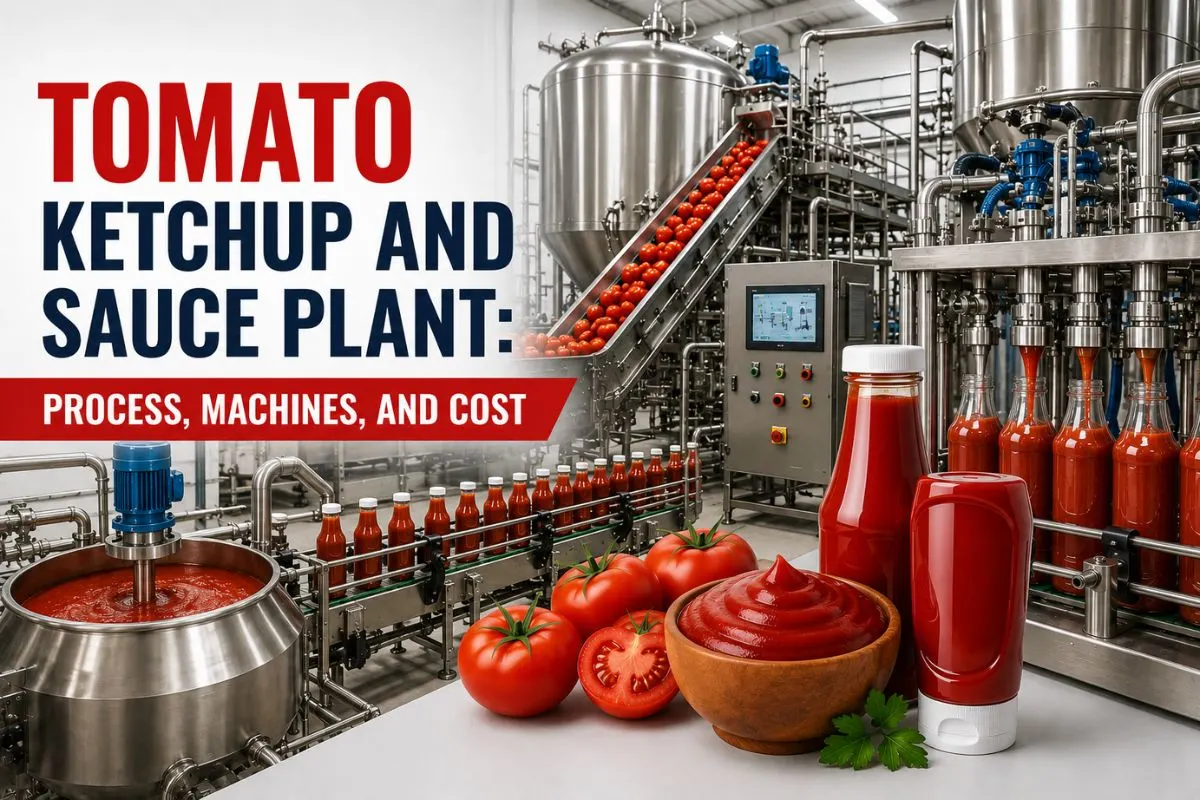
Tomato ketchup is the widely consumed condiment worldwide. From the fast food chains to restaurants and households, the demand for ketchup grows. So it is important to invest in the tomato ketchup and sauce manufacturing plant to open a profitable business.
You can set up the ketchup-making machine and sauce plant to process fresh tomatoes into hygienically packed products with consistent color, texture, taste, and shelf life. The production process consists of various stages, including cleaning, pulping, concentration, blending, cooking, filling, and packaging.
Whether you want to open a small-scale unit or a fully automated commercial facility, you must understand the equipment’s essentials, costs involved, and other requirements, and ensure successful operations.
About the Ketchup Making Machine
The tomato ketchup plant processing involves various stages, such as washing tomatoes using a Fruit Vegetable Washing Machine, crushing them with a fruit crusher machine, extracting pulp using a Fruit Pulp Machine, cooking, mixing ingredients in Industrial Mixing Tanks, filling, and packaging. Each step requires specialized equipment to ensure hygiene, consistency, and product quality.
Modern Food Processing Machinery in Rajkot is designed to streamline these operations, improve efficiency, and maintain industry standards. The total investment depends on factors such as production capacity, level of automation, machinery quality, and compliance requirements.
Small-scale units require less capital, while medium and large-scale plants need higher investment but offer more output and efficiency. It is important to understand the production process to estimate costs accurately. Here are the overview of the sauce processing line process
1. Raw Tomato Reception and Sorting
First, the fresh tomatoes are inspected and sorted to remove damaged or unripe produce.
2. Washing and Cleaning
All tomatoes are washed properly with automated machines to remove impurities and dirt.
3. Pulp Extraction
Next, clean tomatoes are crushed and pulped to separate seeds and skin, producing smooth tomato pulp.
4. Cooking and Concentration
The pulp is cooked in steam jacketed kettles to achieve the desired thickness and flavor.
5. Mixing of Ingredients
Then the ingredients like sugar, salt, spices, vinegar, and preservatives are mixed in precise amounts.
6. Pasteurization
Now, the mixture is pasteurized to ensure food safety and improve shelf life.
7. Filling and Packaging
In the end, the final product is filled into bottles or pouches, sealed, labeled, and packed for distribution.
Each stage requires specialized machinery, making the choice of equipment supplier crucial for project success.
Machinery Required for a Tomato Ketchup and Sauce Plant
Here are the machines required to operate the sauce processing line
1. Tomato Washer & Sorting Conveyor
The Tomato Washer & Sorting Conveyor is used to wash tomatoes continuously and remove dirt and impurities. It also allows operators to inspect and remove damaged or unripe tomatoes and maintain hygiene. It also ensures only high-quality raw materials enter the production line.
2. Crusher / Hammer Mill
The crusher breaks tomatoes into smaller pieces before pulping. It works efficiently to improve extraction efficiency, support smooth downstream processing, and prepare tomatoes for effective pulp separation and sauce production.
3. Tomato Pulper
A tomato pulper separates seeds, peels, and fibrous materials from the pulp, producing smooth tomato puree. This puree serves as the main ingredient for ketchup, sauces, and other tomato-based products.
4. Jacketed Kettle / Cooking Vessel
Jacketed Kettle / Cooking Vessel is used to blend tomato pulp with sugar, salt, vinegar, and spices while providing controlled heating. Hence, it helps in thickening, cooking, reduction, and flavor development to achieve the desired ketchup consistency.
5. Homogenizer
A homogenizer is another machine required to run the sauce processing line. It reduces particle size and creates a uniform texture throughout the product. It prevents ingredient separation, improves product stability, and enhances the overall appearance and mouthfeel of ketchup.
6. Pasteurizer & Deaerator
The pasteurizer eliminates harmful microorganisms, while the deaerator removes trapped air from the product. Together, they enhance product quality, extend shelf life, and facilitate safe and efficient packaging.
7. Sauce Filling Machine
The Sauce Filling Machine is another machine required to set up the sauce manufacturing plant. It is designed for high-viscosity products. It is used to fill ketchup and sauces into bottles, jars, pouches, or other packaging formats. They improve production speed and minimize product waste.
8. Capping & Labeling Machines
These machines securely seal containers and automatically apply labels. They enhance packaging efficiency, maintain product freshness, ensure leak-proof sealing, and create a professional retail-ready appearance.
Tomato Ketchup and Sauce Plant Setup Cost Estimates
The total cost of the setup of the ketchup-making machine includes machinery, installation, utilities, factory setup, licensing, quality control equipment, packaging infrastructure, and initial working capital.
| Plant Scale | Production Capacity | Machinery Cost | Total Setup Cost* |
| Small-Scale (Startup / Micro Enterprise) | 50 kg to 200 kg per hour | ₹2 lakh – ₹5 lakh | ₹5 lakh – ₹15 lakh |
| Medium-Scale (Commercial Plant) | 500 kg to 1,000 kg per hour | ₹10 lakh – ₹25 lakh | ₹20 lakh – ₹50 lakh |
| Large-Scale (Industrial Plant) | 1 to 3+ tonnes per hour | ₹50 lakh – ₹1 crore+ | ₹1 crore – ₹3 crore+ |
Major Cost Components in Setting Up a Tomato Ketchup Plant
Here are the cost components involved in setting up the Tomato Ketchup Plant
1. Land and Infrastructure Cost
The first cost involved is the land and construction or rental. A small ketchup manufacturing plant can operate in a limited space, but a larger facility requires more area for processing, storage, utilities, and packaging.
2. Machinery and Equipment Cost
Machinery is crucial for a ketchup plant. High-quality machines ensure smooth operations, food safety, and consistent taste. Machine prices depend on capacity, material quality (like stainless steel), and level of automation. Fully automatic plants cost more but decrease labor dependency and improve efficiency.
3. Raw Material Cost
Raw materials costs include buying fresh tomatoes, spices, salt, sugar, vinegar, preservatives, and water. The quality and seasonal availability of tomatoes can greatly influence production costs. Buying in bulk during harvest times helps lower expenses. Packaging materials such as bottles, pouches, caps, labels, and cartons are also part of raw material costs.
4. Labor and Workforce Costs
Labor costs vary based on the automation level of the ketchup-making machine. Manual and semi-automatic plants require more workers for operations, quality checks, and packaging. Fully automatic plants need fewer skilled operators and technicians.
5. Utilities and Operational Costs
Utility costs include electricity, water, fuel, and maintenance. Machines like sauce-making machines and cooking kettles consume significant energy, making energy-efficient equipment a wise investment.
Why Choose Envitro Technomech for Sauce Processing Machinery & Equipment
At Envitro Technomech, we provide optimized ketchup processing units designed for durability, performance, and food-grade compliance. Here is what makes us the best tomato sauce plant manufacturer in India
- Customized equipment based on plant size
- User-friendly controls and automation
- Reliable after-sales support
- Energy-efficient operation
Whether you’re looking for a single ketchup-making machine or a complete production line with a tomato sauce-making machine and packaging systems, we offer solutions built for long-term success.
Conclusion
Setting up the tomato ketchup manufacturing industry provides you with great opportunities because of growing consumer demand, expansion in the food service sector, and increasing processed food markets. Its cost varies on the basis of factors like machinery, capacity, automation level, and infrastructure. So you have to do the proper planning and invest wisely to start a profitable venture.
By buying the essential equipment from a trusted tomato sauce plant manufacturer in India, like Envitro Technomech, you can streamline the setup process and establish a modern tomato ketchup manufacturing facility.
Also Read: Soft Drink Processing Plant: Equipment List and Setup Cost
FAQs
Q1. What is the Ideal Production Capacity for a Tomato Ketchup and Sauce Plant?
Ans: It depends on your budget and market demand. The small plants may process a few hundred kilograms daily, and the commercial facilities process various tons of tomatoes daily.
Q2. Which Are Required Materials for Tomato Ketchup Manufacturing?
Ans: Fresh tomatoes are the main material required for the tomato ketchup production. It also requires other materials like salt, sugar, spices, vinegar, stabilizers, and preservatives.
Q3. Can the Same Tomato Ketchup Plant Produce Different Types of Sauces?
Ans: Yes, it produces different types of sauces like pizza sauces, tomato sauces, chili sauces, pasta sauces, and other condiments.
Q4. How Much Space is Required to Install a Tomato Ketchup Processing Plant?
Ans: Space requirements vary as per the automation level and plant capacity. Your facility must accommodate equipment, packaging sections, storage areas, utilities, material movement, and quality control.
Q5. Why is Automation Important in a Tomato Ketchup Manufacturing Plant?
Ans: Automation is important in a plant because it improves production efficiency, reduces labor dependency, and ensures consistent product quality. It also reduces wastage, enhances food safety compliance, and increases productivity for large-scale manufacturing.