
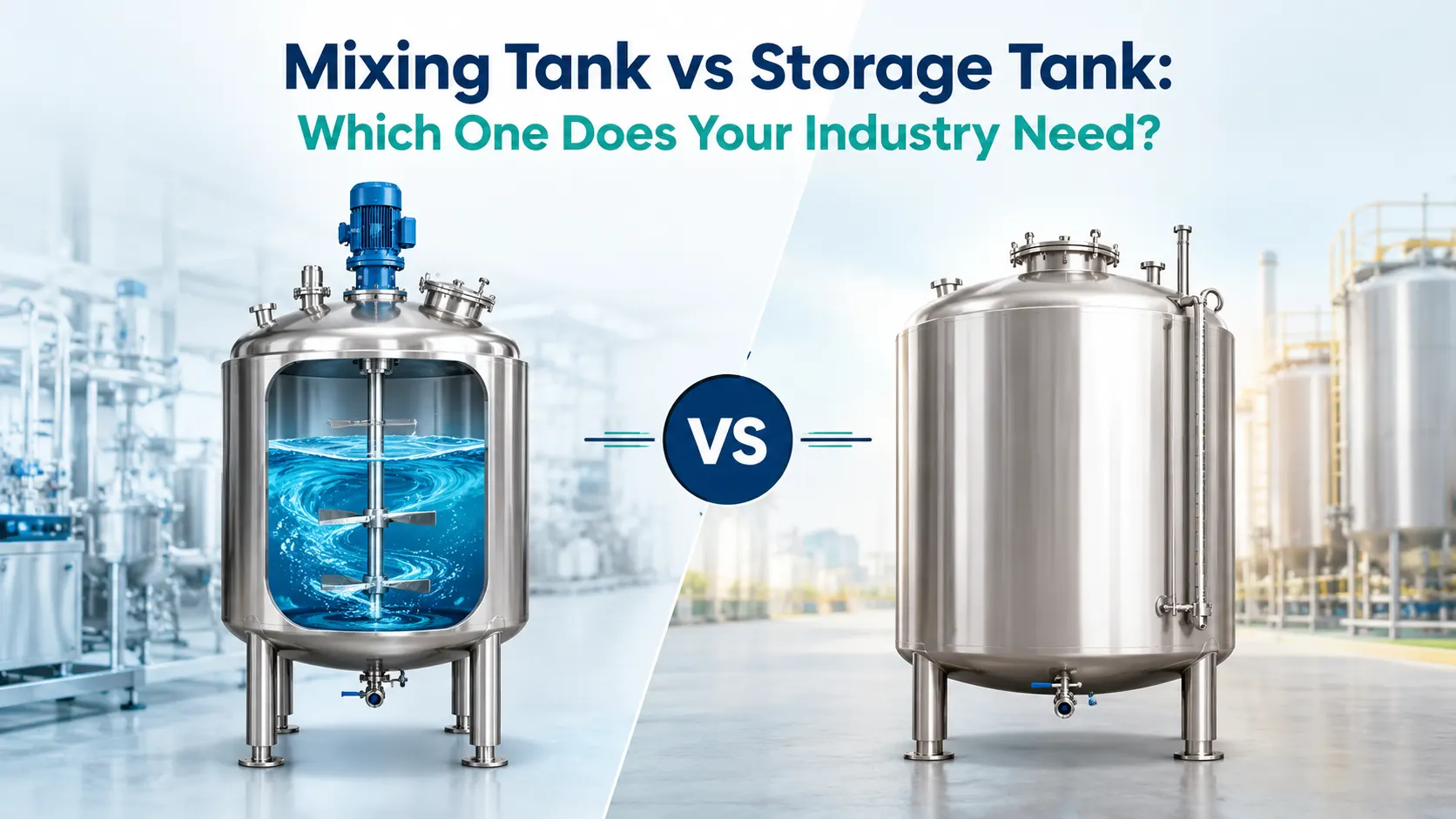
Industrial tanks play an important role in maintaining product quality, process efficiency, and safe material handling across manufacturing industries. From food processing and dairy production to pharmaceuticals and chemical manufacturing, selecting the right tank is essential for smooth plant operations.
However, not every industrial tank serves the same purpose. A mixing tank is designed to combine ingredients, dissolve materials, and achieve a consistent product through controlled agitation. In contrast, a storage tank is primarily used to hold raw materials, intermediate products, or finished liquids under suitable storage conditions.
Understanding the difference between a mixing tank vs storage tank helps manufacturers select equipment based on their production process, material characteristics, capacity requirements, and temperature conditions.
In this guide, we will compare their working mechanisms, design features, industrial applications, and selection factors to help you determine which tank is suitable for your manufacturing facility.
What is a Mixing Tank?
A mixing tank is an industrial vessel designed to combine two or more ingredients or materials to achieve a uniform mixture. It is commonly used for processing liquids, powders, viscous substances, and semi-solid materials across food processing, dairy, pharmaceutical, and chemical industries.
Unlike conventional storage vessels, mixing tanks are equipped with mechanical agitation systems that continuously move the materials inside the tank. These systems generally consist of an electric motor, gearbox, agitator shaft, and impellers or mixing blades. Depending on the application, baffles may also be installed to improve mixing efficiency and minimise unwanted swirling.
Some mixing tanks are additionally equipped with heating or cooling jackets to maintain the required processing temperature. The agitator type, mixing speed, and tank configuration are selected according to the product’s viscosity, ingredients, and required consistency.
For example, in a beverage manufacturing plant, a mixing tank can combine water, sugar syrup, and flavouring ingredients to achieve a consistent formulation before the next processing stage.
Key Functions of a Mixing Tank:
- Combine multiple ingredients into a uniform mixture.
- Dissolves powders and other soluble materials in liquids.
- Disperses ingredients throughout the processing medium.
- Supports emulsification and blending, depending on agitator design.
- Maintains required processing temperatures when equipped with heating or cooling arrangements.
What Is an Industrial Storage Tank?
An industrial storage tank is a vessel designed to hold raw materials, intermediate products, and finished liquids safely until they are required for further processing, packaging, or distribution. These tanks are widely used in food processing, dairy, beverage, pharmaceutical, chemical, and water treatment facilities.
Unlike mixing tanks, standard storage tanks do not require continuous agitation. Their primary purpose is to maintain suitable storage conditions while protecting the stored material from contamination, leakage, and unwanted environmental exposure.
Industrial storage tanks are available in different configurations depending on the product being stored and the requirements of the manufacturing process. Vertical and horizontal designs are selected according to available space, storage capacity, and installation requirements. Insulated tanks help minimise heat transfer, while jacketed tanks can support temperature control when designed with an appropriate heating or cooling arrangement.
For example, dairy processing plants use insulated storage tanks to maintain suitable conditions for milk before further processing. Similarly, beverage manufacturers use storage tanks to hold prepared liquids before filling and packaging.
Key Functions of Industrial Storage Tanks:
- Stores raw materials and finished liquid products.
- Maintains suitable storage conditions for different materials.
- Supports continuous production by providing a buffer between processing stages.
- Helps protect stored materials from external contamination.
- Facilitates organised material handling and transfer.
Mixing Tank vs Storage Tank: Key Differences
Although mixing tanks and storage tanks may have a similar physical appearance, their design, equipment configuration, and operational purposes are different. Understanding these differences helps manufacturers select the right vessel for their production requirements.
| Parameter | Mixing Tank | Storage Tank |
| Purpose | It blends ingredients properly | It holds material safely and store them |
| Key part | Agitator or mixer is vital part | Tank body with inlet and outlet |
| Product result | It gives Uniform texture and consistency | It gave stable storage and supply |
| Best for | Ideal for making dairy products, medicines and more | Ideal for storing milk, chemicals, and other liquid |
Below are three major differences between mixing tanks vs storage tanks, helping you to find your best choice.
1. Working Mechanism
The primary difference between a mixing tank and a storage tank is how the materials are handled inside the vessel.
Mixing Tank Working Mechanism:
A mixing tank works through mechanical agitation. Ingredients are introduced into the tank, where an agitator connected to a motor and gearbox rotates at a selected speed. The impellers or mixing blades create movement within the material, helping distribute different ingredients throughout the vessel.
The mixing process depends on factors such as ingredient properties, viscosity, agitator design, and required mixing time. Once the desired consistency or formulation is achieved, the processed material can be transferred to the next production stage.
Storage Tank Working Mechanism:
A storage tank works primarily through material holding and controlled transfer. Raw materials or processed liquids enter through an inlet and remain inside the vessel until they are required for further production or distribution.
Depending on the application, storage tanks may include level indicators, temperature monitoring arrangements, vents, manholes, and suitable outlet connections. Insulation or heating and cooling arrangements may also be incorporated when temperature maintenance is necessary.
Unlike a standard storage tank, a tank equipped with an agitator can provide additional mixing or circulation functionality when the process requires it.
2. Equipment Design
Mixing tanks and storage tanks are designed according to their specific operating requirements.
Mixing Tank Design:
A typical industrial mixing tank consists of a stainless steel vessel, electric motor, gearbox, agitator shaft, and impellers. The agitator configuration is selected according to the material’s viscosity, mixing requirements, and desired processing results.
Depending on the application, the design may also include:
- Internal or external baffles to improve mixing performance.
- Heating or cooling jackets for temperature control.
- Bottom or side discharge arrangements.
- Suitable manholes and inspection openings.
- Hygienic fittings and cleaning provisions.
Storage Tank Design:
Storage tanks generally have a simpler internal arrangement because their primary purpose is material holding. Their design focuses on storage capacity, structural strength, material compatibility, and safe material transfer.
Depending on the application, they may include:
- Insulation for reducing heat transfer.
- Heating or cooling jackets where required.
- Inlet and outlet connections.
- Level indicators and temperature sensors.
- Manholes, vents, and cleaning arrangements.
- Structural support based on installation requirements.
Both types of tanks can be manufactured in stainless steel grades such as SS 304 and SS 316, depending on the material being handled, corrosion resistance requirements, hygiene considerations, and operating conditions.
3. Operational Benefits
The operational benefits of each tank depend on its role in the manufacturing process.
Benefits of Mixing Tanks:
- Supports consistent ingredient blending and formulation.
- Helps achieve the required product texture and uniformity.
- Reduces manual mixing requirements.
- Supports controlled processing through adjustable agitation.
- Can integrate heating and cooling arrangements for temperature-sensitive processes.
Benefits of Storage Tanks:
- Provides sufficient holding capacity for raw materials and finished products.
- Helps maintain continuity between different manufacturing stages.
- Supports organised material handling and liquid transfer.
- Helps minimise exposure to external contamination through appropriate hygienic design.
- Provides storage flexibility based on production volume and plant requirements.
Key Industrial Applications of Mixing Tanks
Mixing tanks are used in industries where different ingredients or materials need to be combined under controlled processing conditions. The agitator design, tank material, and operating configuration depend on the specific application.
1. Food and Beverage Industry
Mixing tanks are widely used in food and beverage manufacturing for preparing juice blends, syrups, sauces, dairy-based products, and liquid formulations. They help combine ingredients such as water, sugar, flavourings, and other components to achieve the required product consistency.
2. Dairy Industry
Dairy processing plants use mixing tanks for blending milk with ingredients such as sugar, stabilisers, and flavouring agents. Depending on the formulation, suitable agitation helps distribute ingredients evenly before subsequent processing stages.
3. Pharmaceutical Industry
Mixing tanks are used to prepare liquid formulations, solutions, and other pharmaceutical products. These applications may require controlled agitation, suitable material selection, hygienic construction, and precise process conditions.
4. Chemical Industry
Chemical manufacturers use mixing tanks to combine solvents, additives, and other compatible materials. Agitator selection depends on chemical properties, viscosity, and the required degree of blending.
5. Paint and Coating Industry
Mixing tanks help combine pigments, resins, solvents, and additives during paint and coating production. Depending on the formulation, specialised agitators or high-shear mixing equipment may be required to achieve proper pigment dispersion.
6. Wastewater Treatment Industry
Mixing tanks are used for preparing and distributing chemical solutions, including coagulants and flocculants, during wastewater treatment processes. Proper agitation helps maintain the required chemical distribution before dosing or treatment.
Key Industrial Applications of Storage Tanks
Industrial storage tanks are essential for holding raw materials, intermediate products, and finished liquids between different stages of manufacturing. Their capacity, material, and configuration are selected according to the properties of the stored product.
1. Dairy Industry
Dairy processing plants use insulated stainless steel storage tanks to hold milk, cream, and other dairy liquids before further processing. Temperature management is particularly important for maintaining the required storage conditions and product quality.
2. Food and Beverage Industry
Storage tanks are used to hold fruit pulp, juice blends, syrups, liquid ingredients, and prepared products before processing or packaging. They help maintain a continuous supply of materials across different production stages.
3. Pharmaceutical Industry
Pharmaceutical manufacturing facilities use storage tanks for holding purified water, process liquids, and suitable liquid formulations. These tanks may require hygienic construction, appropriate material selection, and cleaning provisions according to the application.
4. Chemical Industry
Chemical processing plants use storage tanks to hold compatible raw materials, solvents, and finished chemical products. Material selection, corrosion resistance, and tank configuration are important considerations for safe storage.
5. Water Treatment Industry
Industrial water treatment facilities use storage tanks to hold raw water, treated water, and process water. They provide a buffer between treatment, distribution, and consumption stages.
What Factors Should You Consider Before Choosing a Mixing or Storage Tank?
Selecting the right industrial tank requires evaluating your production process, material characteristics, operating conditions, and available installation space. The following factors can help manufacturers make an informed decision when comparing a mixing tank vs storage tank.
1. Identify Your Process Requirements
Start by understanding the primary function of the tank in your manufacturing process.
If your process involves blending ingredients, dissolving powders, dispersing materials, or preparing liquid formulations, a mixing tank with a suitable agitation system is required.
If your requirement is to hold raw materials, intermediate products, or finished liquids before further processing, a storage tank may be more appropriate.
2. Select the Appropriate Construction Material
The tank material should be compatible with the product being handled. Stainless steel is widely used in food, beverage, dairy, and pharmaceutical applications because of its corrosion resistance, durability, and suitability for hygienic construction.
SS 304 and SS 316 are common stainless steel grades. The final selection depends on the chemical composition of the product, cleaning agents, operating environment, and corrosion resistance requirements.
3. Determine the Required Tank Capacity
Tank capacity should be calculated according to production volume, batch size, material holding requirements, and available space.
For mixing tanks, consider the working volume required for effective agitation and sufficient space for material movement. For storage tanks, consider the quantity of material that must be held between production stages.
The usable working capacity may differ from the tank’s total geometric capacity.
4. Evaluate Temperature Requirements
Some industrial processes require materials to be heated, cooled, or maintained within a specific temperature range.
Mixing tanks may use heating or cooling jackets to support temperature-controlled processing. Storage tanks may incorporate insulation or jacketed arrangements to maintain suitable storage temperatures.
The appropriate arrangement depends on the product characteristics and process requirements.
5. Consider Cleaning, Hygiene and Safety
For food, beverage, and pharmaceutical manufacturing, hygienic tank construction is particularly important.
Consider smooth internal surfaces, suitable weld finishing, appropriate fittings, drainability, and cleaning provisions. Depending on the process, CIP (Clean-in-Place) arrangements may also be required.
Tank design should also account for operating pressure, temperature, structural loading, and applicable safety and industry requirements.
6. Evaluate Available Installation Space
The tank’s dimensions and orientation should match the available factory layout.
Vertical tanks may be suitable where floor space is limited and sufficient height is available. Horizontal tanks may be considered where the installation layout or process configuration requires them.
Also consider accessibility for maintenance, cleaning, material transfer, and equipment operation.
7. Check Agitation and Automation Requirements
For mixing tanks, the agitator type, motor capacity, mixing speed, and impeller configuration should match the material’s viscosity and processing requirements.
For storage tanks, consider whether level monitoring, temperature sensors, automatic valves, or other process controls are needed.
These considerations help ensure that the selected tank supports the actual production requirements.
Why Is Proper Tank Selection Important for Industrial Manufacturing?
Industrial tanks are an important part of manufacturing infrastructure because they directly influence how materials are processed, handled, and stored.
Selecting the wrong tank configuration can create operational challenges, increase maintenance requirements, and affect production efficiency.
For example, using a storage tank where continuous ingredient blending is required may result in inconsistent product formulations. Similarly, using a mixing tank for a process that only requires material holding may introduce unnecessary equipment and operational costs.
For food and beverage manufacturers, appropriate tank selection also supports hygienic material handling, consistent processing conditions, and organised production workflows.
This is why manufacturers should evaluate their production requirements, material characteristics, tank capacity, and operating conditions before finalising an industrial tank design.
Can a Mixing Tank Also Be Used as a Storage Tank?
Yes, certain mixing tanks can also be used for temporary material holding, depending on their design and application requirements. However, a mixing tank and a storage tank are not automatically interchangeable.
A mixing tank is primarily designed with an agitation system to combine ingredients and achieve the required product consistency. After the mixing process is complete, the same tank may temporarily hold the processed material before it is transferred to another production stage.
However, if the material needs to be stored for an extended period, the tank must be suitable for the required storage conditions. Factors such as temperature control, product stability, hygiene, agitation requirements, and cleaning arrangements should be evaluated.
Similarly, a conventional storage tank can only perform mixing operations if it is specifically designed or modified with a suitable agitation system and other necessary components.
For manufacturers, the right decision depends on whether the process requires mixing, storage, or both operations within the same vessel.
How to Choose the Right Tank for Your Industry?
The right tank depends on the type of material being handled and the manufacturing process involved. Different industries have different requirements for agitation, storage capacity, temperature control, and hygienic construction.
Here are some examples:
| Industry | Mixing Tank Requirement | Storage Tank Requirement |
| Food Processing | Blending ingredients, sauces and liquid formulations | Holding juice, pulp, syrups and finished liquids |
| Dairy | Mixing milk with ingredients and additives | Storing milk, cream and other dairy liquids |
| Beverage | Preparing juice blends, syrups and beverage formulations | Holding prepared beverages before filling |
| Pharmaceutical | Preparing liquid formulations and solutions | Holding purified water and suitable process liquids |
| Chemical | Blending solvents, additives and compatible chemicals | Storing compatible raw materials and finished chemicals |
Conclusion
Choosing between a mixing tank vs storage tank depends on the specific requirements of your industrial process. Mixing tanks are designed to combine ingredients, achieve uniform formulations, and support controlled processing. Storage tanks, on the other hand, are used to hold raw materials, intermediate products, and finished liquids under suitable storage conditions.
Before selecting a tank, manufacturers should evaluate factors such as production capacity, material compatibility, agitation requirements, temperature control, hygiene, and available installation space.
For many food processing, dairy, beverage, pharmaceutical, and chemical manufacturing facilities, both mixing and storage tanks are essential for maintaining an organised and efficient production workflow. As experienced food processing machinery manufacturers, Envitro Technomech provides industrial equipment solutions designed to support diverse manufacturing and processing requirements.
Envitro Technomech offers industrial tank and processing equipment solutions designed around different manufacturing requirements. Whether your plant requires a mixing system or a storage solution, selecting the appropriate tank configuration is important for achieving reliable industrial operations.
Looking for the right industrial tank for your manufacturing facility? Contact Envitro Technomech to discuss your application and tank requirements.
Also Read: Difference Between Thermal and Non-Thermal Food Processing
FAQs
Q1. What Is the Main Difference Between a Mixing Tank and a Storage Tank?
A mixing tank is designed to combine ingredients using an agitation system to achieve a uniform mixture. A storage tank is primarily used to hold raw materials, intermediate products, or finished liquids under suitable storage conditions.
Q2. Which Tank Is Best for the Food Processing Industry?
Both mixing tanks and storage tanks are important in food processing. Mixing tanks are used for preparing sauces, juice blends, syrups, and other formulations, while storage tanks hold raw materials and processed liquids before further production or packaging.
Q3. Can a Storage Tank Be Used for Mixing?
A conventional storage tank is not designed for mixing. However, it can be equipped with a suitable agitator system if its structure, material, and operating conditions support the modification.
Q4. Which Stainless Steel Grade Is Suitable for Industrial Tanks?
SS 304 and SS 316 are commonly used for industrial tank manufacturing. The appropriate grade depends on the stored or processed material, corrosion resistance requirements, cleaning conditions, and industry application.
Q5. What Factors Determine the Capacity of an Industrial Mixing Tank?
Mixing tank capacity depends on batch size, production volume, material viscosity, mixing requirements, and the space needed for effective agitation. The usable working volume should also be considered while determining the tank’s total capacity.
Q6. Why Are Insulated Storage Tanks Used in Dairy and Beverage Industries?
Insulated storage tanks help reduce heat transfer between the stored product and its surroundings. They are useful when maintaining suitable product temperatures is necessary during storage.
Q7. Does Envitro Technomech Provide Customized Industrial Tanks?
Envitro Technomech provides industrial tank and processing equipment solutions for different manufacturing applications. Tank specifications and configurations can be discussed according to individual production requirements.